

The best hurricane plan for an older adult in Lee, Collier or Charlotte County is made before a storm is in the forecast. It answers four questions: what evacuation zone your loved one lives in, where they will go and how they will get there, what they need to bring, and who will check on them. Special needs shelters have limited space and are meant for people with medical needs, such as dependence on electricity or oxygen. If your parent qualifies, register early, because counties stop processing applications once a storm’s forecast cone reaches them. Everyone else is welcome at a general public shelter. A clear plan, shared with family and any private caregiver, makes stressful storm days far more manageable.
Does your loved one need more help when storms threaten?
- Look up your loved one’s evacuation zone now. Florida’s zones run from A (evacuates first) to F.
- Special needs shelters are limited to people with medical needs a general shelter can’t meet, such as dependence on electricity or oxygen. Everyone else can use a general public shelter.
- If your parent qualifies, register through your county. Registering does not reserve a spot, and a caregiver or companion is expected to come along.
- Pack a go-kit with medications, a written medication list, insurance cards, glasses, hearing aids and chargers.
- Choose one main emergency contact and one backup outside the area, and share the plan with everyone involved.
- Talk with your private caregiver early about their own storm plans and what they’re able to help with.
Step 1: Know the Zone and the Plan
According to the Florida Division of Emergency Management’s Know Your Zone page, storm surge is the greatest threat to life during a hurricane. Zone A is the most vulnerable and usually the first to evacuate. You can enter your parent’s address on the state map to find their zone. People who live in an evacuation zone that’s under an order, in a low-lying area that floods (you can check the address on FEMA’s flood maps), or in a mobile home should leave when told to.
Next, decide where your loved one would go. Many people stay with family or friends outside the zone, or in a hotel inland. Public and special needs shelters are a safety net, not the first choice. Decide in advance who will drive, and leave early, because traffic and fuel get harder by the hour.
Lee County offers AlertLee notifications by phone, text and email, along with the free LeePrepares app, which includes evacuation zone maps and shelter information. Sign up your parent and yourself, especially if you live out of town.
Step 2: Know Which Shelter Fits Your Loved One
Special needs shelters have very limited space. They’re meant for people whose medical needs a general shelter can’t meet, but who don’t need a hospital. Not everyone who is older or has a disability needs a special needs shelter. Here’s how Lee and Collier County Emergency Management describe the difference:
May qualify if your loved one:
- Depends on electricity for medical needs, such as oxygen, a ventilator, a nebulizer or dialysis
- Needs care beyond basic first aid, but not a hospital
- Has a chronic condition or disability that requires help with daily activities
The right choice if your loved one:
- Can manage with help from family or a caregiver
- Has a disability or health condition that doesn’t need added medical care
- Has no medical equipment that depends on electricity
General public shelters are open to everyone. People living in a nursing home or assisted living facility should follow the facility’s emergency plan instead of registering. And a shelter of either kind is for people who have no other safe place to go.
If your loved one does qualify, Florida’s Special Needs Registry, run by the Florida Department of Health, collects information that is used only for emergency planning and services. Each county has its own process:
| County | How to register | Good to know |
|---|---|---|
| Lee | Online at shelterapp.leegov.com or call (239) 533-0640 | For people whose medical needs depend on electricity. Update your information every year, and note that applications stop once Lee County is in a storm’s seven-day forecast cone. A companion or caregiver needs to come along. Transportation to a shelter is available for those without a ride. (Lee County Special Medical Needs Program) |
| Collier | Online through the state registry at snr.flhealthresponse.com, or call (239) 252-3603 | Registration is required annually. Caregivers are encouraged to accompany the person. The shelter is a backup to a personal plan. (Collier County Special Needs Program) |
| Charlotte | Mail or email the county application to Charlotte County Emergency Management ([email protected]) | Everyone must be accompanied by a caregiver. Applications stop once the county is in the five-day forecast cone. (Charlotte County Special Needs Program) |
All three counties make the same point: registering does not reserve a shelter spot or medical treatment, and it doesn’t replace a personal plan. Shelters typically ask you to bring your own bedding, medications and supplies. Under Florida Statute 252.355, nurse registries and home health agencies share special needs registration information with their clients each year, so feel free to ask Abby Services if you’d like a copy.
Step 3: Pack a Go-Kit for an Older Adult
A general hurricane kit covers water, food and flashlights. An older adult’s kit needs a few more things. Ready.gov recommends planning around medications, medical supplies, assistive devices and the people who can help.
Medications and supplies
At least a week or two of medications in original bottles, a written medication and allergy list, doctors’ phone numbers, incontinence supplies and any wound or skin care supplies the doctor has recommended.
Comfort and mobility
Glasses, hearing aids with extra batteries, dentures, a walker or cane, phone chargers and a power bank, a change of clothes, a pillow and a light blanket.
Documents and cash
Copies of Medicare and insurance cards, a photo ID, health care surrogate or power of attorney papers, an emergency contact list and some cash.
Under Florida Statute 252.358, when a county is under a hurricane warning or a state of emergency, health insurers must allow early prescription refills (if refills remain) for at least a 30-day supply. Ask the pharmacist as soon as a warning is issued. If your parent relies on power-dependent medical equipment, talk with the equipment company and the doctor about a backup plan, and let the electric utility know. During Ian, NBC News found that eight people in Florida died when oxygen machines failed during power outages. FPL customers can enroll in its Medically Essential Service program, which provides advance storm notices but not priority restoration, so a backup power plan is still needed.
Step 4: Set Up an Emergency Contact Plan
During a storm, too many voices can create confusion. Choose one main contact who will keep track of your parent and update the rest of the family, plus a backup, ideally someone who lives outside Florida, since long-distance calls and texts often go through when local lines are jammed.
- Write the plan on one page: zone, destination, driver, contacts, doctors and medications.
- Give copies to family, close neighbors and anyone who helps your parent at home.
- Keep a copy in the go-kit and on the refrigerator.
- Decide how everyone will check in after the storm, since cell service may be spotty for days.
Step 5: Talk With Your Caregiver About Storm Plans
If your loved one has a private caregiver, have this conversation early in the season, not when a storm is three days out. Remember that caregivers have their own homes and families to protect, and they may need to evacuate too. Topics to discuss:
- Whether the caregiver is able and willing to stay with your parent during a storm, travel with them to a family member’s home, or accompany them to a special needs shelter, and what rate you agree on for those hours.
- Who will step in if the caregiver can’t be there. Keep a family backup in mind.
- Where the go-kit, medication list and emergency numbers are kept.
- How you’ll reach each other if phones go down.
Caregivers have their own families and storm worries to manage, too. Some clients and caregivers agree that the caregiver’s spouse or children can stay with them at the client’s home or evacuation spot, so the caregiver can keep helping while knowing their own family is safe. Whether an arrangement like that works is for you and your caregiver to decide together.
For families who want someone in the home more of the time, especially during hurricane season, live-in or around-the-clock help or overnight care may be worth exploring. Abby Services can help identify caregivers whose availability fits your needs, and you and the caregiver agree on the arrangement together. A private caregiver can help with packing, meals, personal care, staying calm and getting ready to leave, while medical questions go to your parent’s doctor.
If your loved one refuses to evacuate
Every storm season, some people in danger zones decide to stay put. We saw it during Hurricane Ian, and the results were deadly. An NBC News investigation found that most of the people who died in Florida were over 65, many lived alone, drowning was the leading cause, and Lee County lost more people than any other county.
A caregiver doesn’t have to put themselves in harm’s way. If your loved one chooses to ignore an evacuation order, the caregiver may decide to leave or not come in, and that decision is theirs to make. If you think a parent may refuse to go, start the conversation early, ask their doctor or someone they trust to help, and decide ahead of time who will drive them. Once a storm arrives, rescue crews may not be able to reach anyone until conditions are safe.
Step 6: Stay Safe After the Storm
Many storm-related injuries happen after the wind dies down. Southwest Florida’s heat and humidity, plus days without power, can be hard on older adults.
- Generators: The CDC says to run generators outside, at least 20 feet from doors, windows and vents, and to have a battery-operated carbon monoxide detector.
- Heat: Older adults are at higher risk of heat-related illness. Without air conditioning, watch for dizziness, confusion or unusual tiredness. Move to a cooler place and offer fluids, as the doctor allows.
- Falls: Debris, wet floors and dark rooms raise the risk of a fall. Keep flashlights within reach and paths clear.
Call 911 for chest pain, trouble breathing, signs of a stroke, or a serious fall. For anything else that seems off, call the doctor.
Staying connected after Hurricane Ian
When Hurricane Ian hit in 2022, my wife, a nurse caring for mothers and babies at HealthPark, was at work at the hospital, and I evacuated with our family to my in-laws’ home in Babcock Ranch. Fort Myers was hit so hard that we stayed there after the storm, too. Babcock Ranch never lost power, phone service or internet, and that turned out to matter a great deal: our office could keep working as a hub, connecting clients with the caregivers they needed while the area recovered.
Caregivers picked back up with the clients they had been helping, often while dealing with their own storm damage. They helped with everything from finding gas for generators, which was in short supply, to filling in for Shell Point residents whose regular caregivers were managing their own crisis or simply couldn’t get there.
Scott Strachan, RN, BSN
That’s why the conversation in Step 5 matters. After a major storm, it helps to know exactly who to call. If your loved one’s caregiver can’t get there, call us at 239-590-0861 and we’ll help you look for a caregiver who can fill in.
Have questions about care at home?
Talk it through with a registered nurse.
Frequently Asked Questions
How do I register my parent for a special needs shelter in Lee County?
Apply online at shelterapp.leegov.com or call Lee County Emergency Management at (239) 533-0640. Information must be updated every year, and a companion or caregiver needs to accompany the person to the shelter.
Who qualifies for a special needs shelter?
Space is very limited. Special needs shelters are generally for people whose medical needs depend on electricity or oxygen, who need care beyond basic first aid but not a hospital, or who have a chronic condition or disability that requires help with daily activities. Everyone else is welcome at a general public shelter. Your county makes the final decision.
Does registering guarantee my parent a spot in a special needs shelter?
No. Lee, Collier and Charlotte Counties all state that registration does not ensure shelter placement. Shelters are a backup option, so every family should still have a personal evacuation plan.
Can a caregiver go with my parent to a special needs shelter?
Yes, and the counties expect it. Lee and Charlotte require a caregiver or companion to accompany the person, and Collier encourages it. Talk with your private caregiver ahead of time about whether they are able to go.
What if my parent refuses to evacuate?
Start the conversation early and ask their doctor or someone they trust to help. A caregiver isn’t required to stay in harm’s way and may choose to leave if a client ignores an evacuation order. During Hurricane Ian, most of the people who died in Florida were over 65, and drowning was the leading cause, so take evacuation orders seriously.
How do I find out my parent’s evacuation zone?
Use the Know Your Zone map on floridadisaster.org and enter the home address. In Lee County, the free LeePrepares app also shows evacuation zones.
Can my parent get prescriptions refilled early before a hurricane?
Often, yes. Florida law requires insurers to allow early refills, for at least a 30-day supply when refills remain, once a county is under a hurricane warning or a state of emergency. Ask the pharmacist as soon as a warning is issued.
Sources
- NBC News: Many Hurricane Ian deaths were preventable, investigation finds
- Florida Division of Emergency Management: Know Your Zone
- Florida Division of Emergency Management: Special Needs Registry
- Lee County Emergency Management: Special Medical Needs Program
- Lee County Emergency Management: Notifications and Resources
- Collier County Emergency Management: Special Needs Program
- Charlotte County Emergency Management: Special Needs Program
- Florida Statutes, Section 252.355: Registry of persons with special needs
- Florida Statutes, Section 252.358: Emergency-preparedness prescription medication refills
- Ready.gov: Older Adults
- CDC: Prevent Carbon Monoxide Poisoning
- CDC: Heat and Older Adults (Aged 65+)
- CDC: Older Adult Falls
- FEMA Flood Map Service Center
- FPL: Medically Essential Service
This article is general information, not medical advice. Talk with your doctor about your specific situation.
When someone you love needs help at home, two very different jobs show up. One is daily life at home: meals, bathing, getting safely to the bathroom, company in the afternoon. The other is the healthcare: the doctors, the medication lists, the test results, the insurance calls and the decisions that come with all of it. A private caregiver helps your loved one live well at home. A nurse care manager helps the family navigate the healthcare. Many Southwest Florida families now use both, and together they help keep a loved one safe, supported and at home, while the family stays in charge of every decision.
Looking for a private caregiver at home?
- A caregiver helps with daily life at home; a care manager coordinates the medical side and the bigger picture.
- A care manager is often a registered nurse or social worker who plans, coordinates and advocates for care.
- Because caregivers referred through Abby Services are independent, you stay in control and decide who joins your care team.
- The pairing helps most after a hospital stay, with many specialists or medications, with memory loss, or when family lives far away.
What is a care manager?
A care manager is a professional, often a registered nurse or social worker, who helps a person and their family plan, coordinate and oversee care. The Aging Life Care Association describes this work as guiding families through the medical, emotional and practical side of aging and chronic illness.
- Attends or helps you prepare for doctor appointments, and explains what was said in plain language
- Reviews medication lists across multiple prescribers and flags questions for the physician or pharmacist
- Coordinates hospital discharge, rehab and the transition back home
- Keeps adult children informed, especially when they live out of town
- Helps the family think through options as needs change
- Acts as a calm point of contact if a crisis happens
How is a care manager different from a caregiver?
The simplest way to think about it: a caregiver helps your loved one live well at home, and a care manager helps the family navigate the healthcare.
Helps your loved one live well at home
An independent caregiver is in the home helping with the daily routine: companion care, personal care such as bathing and dressing, meal preparation, light housekeeping and transportation. Some families need a few hours a week; others need live-in or 24-hour care.
Helps the family navigate the healthcare
A care manager is usually not in the home every day. They look at the bigger picture: whether the care plan still fits, whether something a doctor said needs follow-up, and whether the family has the information it needs to make good decisions.
A caregiver without a plan can only react. A plan without a caregiver has no one at home to carry it out.
How a care manager can work with a caregiver referred by Abby Services
Abby Services is a Florida-licensed nurse registry and caregiver matching service. We identify and refer independent, self-employed caregivers who have been screened for licensure or certification, background checks and references. Because the caregiver is independent, you stay in control of the care. You direct the daily work, and you decide who else is part of your care team. If you are new to this model, our guide on what a Florida nurse registry is explains how it differs from a home care agency.
That independence is where a care manager can be especially helpful. Families who direct their own care sometimes want a clinical professional on their side to help them do it well. Here is what that partnership can look like:
Before care starts
The care manager meets with the family, reviews health history and current needs, and helps define what the caregiver should focus on. That gives Abby Services a clearer picture when we match your family with caregivers, and gives the caregiver a clear starting point on day one.
During care
The caregiver sees your loved one every day and is often the first to notice a change: a new cough, more confusion in the afternoon, a missed meal, a fall risk. The care manager gives the family and caregiver someone to bring those observations to, and helps decide whether it needs a call to the doctor, a change in routine, or just closer watching.
When things change
After a hospital stay, a new diagnosis or a decline in memory, the care manager helps the family update the plan. If the hours or type of help need to change, the family can reach out to Abby Services to discuss a different schedule or additional caregiver referrals.
See our pages on after-surgery home care, hospital and rehab support, and Alzheimer’s and dementia caregiver support for more on those situations.
Many of the families we work with have a parent in Fort Myers, Cape Coral or Naples and children living in other states. A care manager can provide regular updates and be present for appointments when the family cannot, while the caregiver handles the daily support at home.
Who benefits most from a care manager?
Not every family needs one. A care manager tends to be most valuable when:
- Your loved one sees several specialists or takes many medications
- There has been a recent hospitalization, surgery or new diagnosis
- Memory loss is making it harder for your loved one to report what is going on
- Family members are out of town or stretched thin
- The family is facing a decision about the level of care needed and wants an objective clinical opinion
The National Institute on Aging also has practical resources for families sharing caregiving responsibilities, including caring for someone from a distance.
A local care manager and nurse navigator: HavenWell
HavenWell, founded by Erin Mitchell, RN
One local resource we are glad to introduce families to is HavenWell, founded by Erin Mitchell, RN. HavenWell offers healthcare guidance and advocacy for aging adults, people facing a new diagnosis, those living with chronic conditions, and healthy adults who want a trusted healthcare partner in place before they need one. Erin brings both clinical nursing experience and personal experience as a family caregiver, and currently serves clients in Lee and Collier Counties.
HavenWell is an independent business, and Abby Services does not receive any compensation for this introduction. Families who work with HavenWell contract with them directly. You can learn more or schedule a free consultation at havenwell.life.
Abby Services has been matching Southwest Florida families with independent caregivers since 1997.
Our phone is answered 24/7.
Frequently Asked Questions
Does a care manager replace a caregiver?
No. A care manager coordinates and plans care, while a caregiver provides hands-on help at home. Most families who use a care manager still need a caregiver for day-to-day support.
Is a care manager covered by Medicare?
Private care management is generally paid for out of pocket. Some long-term care insurance policies may help with certain services, so it is worth checking your policy. Our page on long-term care insurance has more information.
Can I use a care manager if my caregiver came from Abby Services?
Yes. Caregivers referred by Abby Services are independent, and you direct the care. You are free to bring a care manager onto your team, and many families find the combination works well.
Does Abby Services supervise the caregiver or the care manager?
No. As a nurse registry, Abby Services refers independent caregivers and does not employ or supervise them. A care manager you hire works for you, not for Abby Services. This keeps you in control of decisions about your loved one’s care.
How do I get started?
If you need a caregiver, call Abby Services at 239-590-0861. If you would like help coordinating medical care, you can contact a care manager or nurse navigator such as HavenWell directly. Either one can be your first call.
Contact HavenWell
Erin Mitchell, RN
HavenWell · Care Manager / Nurse Navigator
Serving Lee and Collier Counties
“We navigate the healthcare maze, so you can focus on living well.”
HavenWell can help with healthcare guidance and advocacy, care coordination for aging adults, support after a new diagnosis, managing chronic conditions, and proactive wellness planning. A free initial consultation is available.
Call 239-634-3574Email [email protected]Visit havenwell.life
HavenWell is an independent business. Abby Services does not receive any compensation for this introduction.
Sources
This article is general information, not medical or legal advice. Talk with your doctor about your loved one’s specific needs.
When families start calling around for in-home care, they often hear the same four warnings about nurse registries. Most of them come from competitors who may not fully understand how nurse registries work, though they probably should. Whether it is misinformation or disinformation, the result is the same: families are not getting the full truth. I developed this guide for the Private Care Association, together with attorney Russell Hollrah, to help families get straight answers.
- “Agency caregivers are supervised.” A monthly pop-in visit is not supervision. Day-to-day oversight comes from family, a spouse or the client.
- “Registry caregivers aren’t insured.” Many carry their own malpractice insurance, and we encourage it. Ask.
- “Workers’ comp protects you.” It protects the agency, not necessarily you. Ask the state directly.
- “You’ll be responsible for the caregiver’s taxes.” Take tax questions to your CPA, not a marketing representative.
Myth 1: Agency caregivers are supervised
Some agencies claim to supervise the caregivers they send to a client’s home. But no one can truly supervise a private caregiver in your home without physically being there, and in reality that seldom happens. It is impractical.
In-home care is most typically supervised by family, friends or guardians, sometimes with the help of technology. The “supervisory visits” some agencies arrange are generally an occasional drop-in of up to 20 minutes, and only periodically. Who is supervising the caregiver between visits? A monthly pop-in visit does not equal supervision.
In practice, supervision comes from the people in the home: family members, a spouse, or the client. Every nurse registry should take client requests and concerns seriously and act as the client directs, so the client receives the support and care they want.
We can connect you with a geriatric care manager
We are happy to match you with a geriatric care manager, a professional who can oversee the services you receive and help make sure your needs are met. Care managers check in and coordinate rather than staying in the home, so they work alongside you and your family.
Myth 2: Caregivers with a nurse registry are not insured
If someone tells you this, you are being misled. Professional caregivers who receive client referrals through nurse registries commonly maintain their own professional liability insurance.
You probably should request it. When you ask for a referral, let us know you want a caregiver with their own insurance, and we are happy to match you with one who carries it. It is simply one of the things we match clients and caregivers on, along with schedule, experience and the type of help needed.
We strongly encourage caregivers to carry their own private malpractice policy. It protects both the caregiver and the client they are caring for.
Myth 3: Workers’ compensation will protect you if a caregiver is injured
A nurse registry that refers independent caregivers is not required to carry workers’ compensation insurance. But workers’ comp does not always provide the protection families expect, or are led to believe by someone trying to win their business under false pretenses.
If an agency employee is injured in a client’s home, workers’ comp prevents the caregiver from suing the agency and provides some coverage for medical expenses and lost wages. It does not necessarily prevent the injured caregiver from suing the client. Workers’ comp is designed to protect the employer, not the consumer. For the full legal detail, see the complete Big Four document linked at the end of this article.
And if workers’ comp pays a claim, a client could face legal action from both the caregiver and the workers’ compensation insurer.
Your homeowner’s policy. Policies that include protection for injuries in the home are generally available, and umbrella policies can add even more robust protection. Ask your insurance agent.
Call Florida’s Division of Workers’ Compensation and ask whether an agency’s workers’ comp coverage protects you as the client. They can give you a straight answer, and it is generally this: workers’ comp is not designed to protect the consumer.
Myth 4: If you use a nurse registry, you will be responsible for the caregiver’s taxes
Take your tax questions to your CPA, not to a marketing representative for a home health service trying to win your business. Nurse registries refer professional caregivers who work as independent contractors. These caregivers receive 1099 forms documenting their annual earnings, which are also reported to the IRS. Caregivers are responsible for paying their own taxes.
Past IRS data shows that independent contractors who receive a Form 1099 report about 97% of that income, compared with about 99% for employees who receive a W-2. Statistically, the difference is small.
Want the one-page version?
Download and share the PDF.
Developed by Scott Strachan, RN, BSN, with attorney Russell Hollrah, for the Private Care Association. Tax data: IRS National Headquarters Office of Research, Interactive Tax Gap Map for Year 2001 (2004); U.S. Government Accountability Office testimony. This is general information only and is not legal or tax advice. Please seek your own legal advice before taking action based on it.
Abby Services receives another perfect survey from the Agency For Healthcare Administration.
Yes! Another deficiency free survey for Abby Services! But what does that mean for the seniors throughout Fort Myers & Cape Coral seeking excellent caregivers? It means the patients and families seeking in-home senior care can’t go wrong with Abby Services.
How many deficiency free surveys has Abby Services had?
Our four most recent AHCA standard surveys have all come back deficiency-free — the latest on December 30, 2025. What does it mean to be deficiency free? It means the state arrived unannounced, reviewed our records, our practices, and our caregiver files, and cited nothing. Think of it as getting a really good report card.
| Survey date | Inspection type | AHCA result |
|---|---|---|
| 12/30/2025 | Standard | No deficiencies |
| 12/10/2019 | Standard | No deficiencies |
| 04/18/2018 | Standard | No deficiencies |
| 09/01/2016 | Standard | No deficiencies |
That is four consecutive deficiency-free standard surveys spanning nine years. AHCA publishes these results, so you do not have to take our word for it — look us up yourself on Florida Health Finder.
AHCA’s online portal only goes back to 2013. Abby Services has been licensed and surveyed since 1997, and for most of that time surveys came about every two years. Counting those earlier inspections, we have recorded more than a dozen deficiency-free surveys over the life of the business. We keep those results on file and are glad to share them.
What does a deficiency-free survey mean anyway?
Home Care providers are facing increasing regulatory scrutiny with each passing year. A deficiency-free survey means that Abby Services continues to meet AHCA’s (The Agency for Healthcare Administration’s) standards. Our most recent state inspection confirms it: a 100% deficiency-free survey. It means surveyors reviewed our records, our practices, and our caregiver files, and cited nothing.
Surveys are conducted by AHCA or The Agency For Healthcare Administration. On its website, AHCA states its mission as “Better Health Care for All Floridians.”
They are responsible for the administration of the Florida Medicaid program, licensure, and regulation of Florida’s 48,500 health facilities, including Nursing Homes, and hospitals.
How often do these state inspections take place?
Standard inspections are conducted periodically by the Agency For Healthcare Administration — historically about every two years, though the schedule can vary. Surveyors arrive unannounced and over the course of a day, they interview caregivers & clients, review procedures, and check records for compliance with regulations on care, confidentiality, caregiver screening, patient rights, and quality of services. Abby Services operates at the highest level of quality at all times. We never know when the ‘pop quiz’ will happen, but we are always ready, and our survey records show it.
An excellent state survey means you or your loved one can expect the highest level of service. This is an important factor when considering what In-Home Care Service to use. Some In-Home Care providers are cited for failing to do proper background screenings, failing to maintain specific state-required training, or failing to even maintain a proper business license. These citations only identify issues that were found. Citations result in fines and corrective plans which have to be put in place and followed. Licensed providers’ survey results can be reviewed here.
What you may find in other providers survey results.
Deficiency free survey results can be difficult to achieve. To do so requires a solid knowledge of confusing state regulations. This knowledge must be combined with solid practices to ensure these regulations and guidelines are followed.
Some providers may not have a solid working knowledge of the regulations that govern our industry. This results in incorrectly completed or absent background screenings, missing training to insure a caregiver can competently and safely assist an individual in their home, or even improper or absent emergency plans.
These surveys where non-compliance with state guidelines is discovered require the offending business to correct the issue. if serious enough the deficient findings can result in fines and ultimately suspension of a business license which is required to function.
How to check any provider’s AHCA inspection results
Florida posts inspection reports for licensed home care providers, including nurse registries and home health agencies. You can look up Abby Services, or any provider you are considering, in a few minutes.
- Open AHCA’s public record search.Go to AHCA’s Public Record Search and choose the Statement of Deficiencies tab.
- Choose the provider type and county.Pick “Nurse Registry” or “Home Health Agency,” choose Lee, Collier or Charlotte County, and click Continue.
- Select the provider.Find the name in the list and click Select to see its inspection documents.
- Read the results.A deficiency-free survey has no citations. When a report does list deficiencies, it shows what was cited, and the provider’s plan shows how it was corrected.
For licensing details and any legal actions, the state’s FloridaHealthFinder facility locator is another good place to look.
Compare at least two or three providers the same way. If a report lists deficiencies, ask the provider what happened and what changed. A good provider will explain it plainly.
How do you know if the senior care service is deficiency free?
A deficiency free survey demonstrates that a Senior Caregiver Service is following required state guidelines. You can look up those results yourself using the steps above.
You could just ask. All licensed senior care businesses are required to have their deficiency reports available on site. The business should know what deficiencies they had and what action was taken to correct them. (More alarming is if they dont know their deficiencies or actions taken to correct them).
Abby Services is proud to share our results. Our history of deficiency-free surveys shows in the caregivers our clients work with.
Arranging in-home care often happens during a stressful time. A parent may be returning home from rehabilitation, a spouse’s needs may have suddenly increased, or a family caregiver may simply need help.
Understandably, families often focus first on finding the right caregiver and determining the hourly cost. But the written agreement matters, too.
Before signing an in-home care agreement, make sure you understand:
- How services and registry fees are paid
- Whether a deposit may be required
- How much notice is requested when changing or canceling a visit
- Whether you could be responsible for a late-canceled visit
- How to end the overall agreement
- Who directs and controls the caregiver’s services
These details should be explained clearly before services begin.
Emergencies happen, especially when someone isn’t well
The first thing I tell families to check is the cancellation policy and how much of a deposit they are being asked to pay. Then ask how far in advance you are committing to pay for scheduled care. Here is why it matters: if Mom has to go into the hospital, are you still expected to pay for the two weeks you had scheduled? With some services, that is exactly what happens. This is health care, and plans change fast.
Scott Strachan, RN, BSN
What Abby Services knows about in-home care agreements
Abby Services has helped seniors and families find independently employed caregivers in Fort Myers, Cape Coral, Naples, and surrounding Southwest Florida communities since 1997.
During that time, we have spoken with many families who did not fully understand the agreement they signed with an in-home care provider. Some encountered unexpected deposit requirements, restrictive cancellation terms, or charges that had not been clearly explained.
An in-home care agreement should not be treated as an obstacle. When written and explained properly, it protects everyone by establishing clear expectations before care begins.
Is “no-contract” in-home care really possible?
Some in-home care providers advertise “no contracts.” That may sound reassuring, particularly when a family is unsure how long care will be needed.
However, “no contract” does not necessarily mean there are no terms or financial obligations.
You may still be asked to sign:
- A service agreement
- A caregiver arrangement
- A payment authorization
- Terms and conditions
- An agreement at each caregiver visit
- An electronic acknowledgment before services begin
Regardless of what the document is called, it may create obligations for the client.
A written agreement is not automatically a negative. The more important questions are whether its terms are understandable, reasonable, and explained before you commit.
If someone tells you there’s no contract, they’re lying. There is always an agreement, so ask to see it in writing.
Scott Strachan, RN, BSN
Why a written in-home care agreement matters
A properly prepared agreement should explain what the service does, what the client is responsible for, and how the relationship can be changed or ended.
Before signing, look for clear information about:
- The hourly rate and any separate fees
- How the caregiver and registry are paid
- Billing frequency
- Cancellation and scheduling requirements
- Potential charges for late cancellations
- Deposit or account-balance requirements
- The process for ending the agreement
- The respective roles of the client, caregiver, and referral service
If something is unclear, ask for an explanation before signing. A reputable provider should be willing to answer your questions and allow you to review the agreement.
How Abby Services approaches its client agreement
Abby Services is a Florida-licensed nurse registry. We refer independently employed caregivers for potential contracts with clients who need help at home.
Florida law defines a nurse registry as a business that procures or offers healthcare-related contracts for caregivers who are compensated as independent contractors. Florida law also requires a nurse registry to explain that referred caregivers are independent contractors and that the registry may not monitor, supervise, manage, or train them. You can review these requirements in Florida Statute § 400.506.
This differs from a traditional home health agency employment model. The client and independently employed caregiver determine their care relationship, schedule, and the services to be provided within the caregiver’s qualifications and legal scope.
Abby Services’ Caregiver Referral Services Agreement explains:
- The services Abby Services provides as a nurse registry
- The client’s selected payment arrangement
- Registry fees and payment responsibilities
- Scheduling and cancellation expectations
- The independent-contractor relationship
- How either party may terminate the registry agreement
Our goal is to explain these terms clearly so families understand how the arrangement works before services begin.
Agreements are tricky things. We want ours to protect both the family and Abby Services, and we have been burned before ourselves. As a small, family-owned business, we take the agreement seriously, but we also know real life needs some flexibility.
In-home care cancellation policies
Cancellation policies are important because caregivers reserve time for their clients. A caregiver may arrange transportation, change personal plans, or decline another opportunity to remain available for a scheduled visit.
At the same time, in-home care needs can change unexpectedly. A client might be admitted to the hospital, enter rehabilitation, attend an unplanned medical appointment, or experience another sudden change.
A reasonable cancellation policy should address both realities.
What to look for in a cancellation policy
Before agreeing to services, ask:
- How much notice is requested?
- How should notice be provided?
- Does the policy apply to both cancellations and schedule changes?
- What happens if the client refuses a scheduled visit?
- What happens if the caregiver is sent home early?
- Is the client responsible for a minimum number of hours or the entire scheduled visit?
- Is there any flexibility for emergencies or unexpected circumstances?
Do not assume that canceling a scheduled visit and terminating the entire service agreement are the same thing. They may have different requirements.
How cancellations work with Abby Services
Cancellation terms are part of the terms you offer your caregiver when you set up care. Most caregivers ask for at least 24 hours’ notice to cancel or change a visit. Unless you choose different terms, you offer to pay for the full scheduled visit if it is canceled with less than 24 hours’ notice, refused when the caregiver arrives, or ended early. You can choose different terms when you set up care, and you and your caregiver can adjust them later.
These terms exist because caregivers reserve time for their clients and may have turned down other work to keep it open.
We are a small, family-owned business, and we know circumstances involving an older adult can change unexpectedly. If you think a schedule may change, let your caregiver and our office know as soon as possible. The more notice there is, the easier it is for everyone to find a reasonable solution.
Canceling a visit versus ending the agreement
Canceling or modifying one scheduled visit is different from terminating the overall Caregiver Referral Services Agreement with Abby Services.
The agreement may be terminated by either party with at least 24 hours’ prior written notice, including notice provided by email.
Ending the agreement with Abby Services does not automatically terminate the client’s relationship with an independently employed caregiver. Under the nurse registry model, only the client and caregiver can make changes to or end their direct care relationship.
Families should make sure they understand both:
- The policy for changing or canceling a particular visit; and
- The process for terminating the overall registry agreement.
In-home care deposits and account balances
Deposit policies can vary considerably among in-home care providers. Some require a substantial advance deposit before services begin. Others require enough money to cover one or more weeks of anticipated services.
A deposit is not necessarily unreasonable, but its purpose and terms should be clearly explained.
Before providing a deposit, ask:
- Is the deposit required for every client?
- How was the amount determined?
- Where will the money be held?
- When can the funds be used?
- Who owns the money while it is being held?
- What happens to unused funds when services end?
- Could the required amount change if the schedule changes?
Avoid relying on verbal assurances. The deposit terms should appear in the written agreement or related payment documents.
The Abby Services approach to deposits
Abby Services does not typically require every client to provide a deposit.
However, a deposit or sufficient account balance may be required in certain circumstances when a client selects Abby Services’ escrow or third-party-payor arrangement. This arrangement allows Abby Services to receive funds and facilitate authorized payments to the independently employed caregiver and the registry.
When a deposit is required, the amount is based on the anticipated schedule and cost of services. The agreement notes that an initial deposit is typically around $1,000, although the amount may be adjusted depending on the circumstances.
Funds held in the escrow account remain the client’s property until they are properly disbursed. After services end and all authorized amounts have been paid, any remaining client funds are refunded.
Clients may also select a direct-pay arrangement in which they are responsible for paying the independently employed caregiver directly through an agreed payment method. The applicable billing procedures and rates can vary based on the payment arrangement selected.
The important point is that any possible deposit requirement should be disclosed and explained before services begin.
Why families switch to a nurse registry
When families come to Abby Services from another service, the most common reason is frustration with how their caregiver situation was handled. Some agencies start a family with a great caregiver, then move that caregiver to a new client they are trying to win.
With a nurse registry, the relationship works differently. Once you and your caregiver agree to work together, that relationship is yours. Abby Services does not step in to replace or move your caregiver. Changes happen only when you or your caregiver ask for them.
Questions to ask before signing an in-home care agreement
When comparing in-home care options in Fort Myers, Cape Coral, Naples, or elsewhere in Southwest Florida, ask each provider the same basic questions.
What exactly am I signing?
Ask whether the document is a service agreement, referral agreement, payment agreement, or employment arrangement. Make sure you understand which parties are entering into the agreement.
Who employs or contracts with the caregiver?
This is an important distinction. With a nurse registry, caregivers are independently employed and enter into a care relationship with the client. A home health agency may instead provide services through employees.
Who controls the caregiver’s work?
Under Florida’s nurse registry model, the client and independently employed caregiver determine their care relationship. The registry refers qualified caregivers but does not employ, supervise, or control them.
What will I pay?
Ask for the hourly rate, minimum scheduling expectations, registry fees, deposit requirements, late fees, and any possible charges for canceled visits.
How can I change the schedule?
Confirm the required notice and how it must be provided. Ask what happens if a hospitalization, emergency, or other unexpected event affects the schedule.
Could I owe money for a canceled visit?
Ask whether you could be responsible for a minimum charge or the entire scheduled visit when notice is provided late.
How do I end the agreement?
Confirm how much notice is required, whether that notice must be written, and where it should be sent.
What happens to unused deposit funds?
If advance funds are required, the agreement should explain how they are held, used, and returned.
Choosing an in-home care service in Southwest Florida
We encourage families to compare their options before selecting an in-home care provider. Speak with more than one service, review the actual agreement, and ask questions about anything you do not understand.
Do not base the decision solely on phrases such as “no contract,” “no commitment,” or “cancel anytime.” Ask what those statements mean in practice.
A trustworthy provider should be willing to explain:
- Its business and caregiver model
- How caregivers are screened and referred
- What the client will pay
- How scheduling and cancellations work
- Whether advance funds may be required
- How the relationship can be ended
You can also use Florida’s official AHCA Provider and Inspection Search to verify whether a provider is licensed and review available regulatory information.
Talk with Abby Services before you make a decision
Abby Services has helped Southwest Florida families find independent in-home caregivers since 1997. We serve Fort Myers, Cape Coral, Naples, Bonita Springs, and surrounding communities in Lee, Collier, and Charlotte counties.
We believe families should understand the agreement, payment options, cancellation policy, and nurse registry model before services begin.
If you have questions about finding an independently employed caregiver or how Abby Services works, call 239-590-0861 or contact us online. We will be happy to explain the process and help you determine whether our registry is an appropriate option for your family.
Frequently asked questions
The questions below address this agreement specifically. For broader questions about scheduling, costs, and caregivers, visit our FAQ page.
Does Abby Services require a long-term contract?
No fixed long-term service commitment is required. Either party may terminate the Caregiver Referral Services Agreement with at least 24 hours’ prior written notice, including email. Ending the registry agreement is separate from ending the client’s care relationship with an independently employed caregiver.
How much notice does Abby Services request when canceling a visit?
Abby Services’ written agreement requests at least 24 hours’ notice to cancel or modify scheduled services. Depending on the circumstances, we may work to accommodate notice given as little as four hours before a visit, but this flexibility is handled case by case and is not guaranteed.
Will I be charged if I cancel a caregiver’s visit?
If a visit is canceled late, refused, or ended early, the client may remain responsible for the originally scheduled visit. This recognizes that the independently employed caregiver reserved the time and may have declined other opportunities.
How do I notify Abby Services about a schedule change?
Clients may call Abby Services at 239-590-0861 during regular business hours to report a schedule change or cancellation. Contacting the office as soon as possible gives us the best opportunity to work with the client and caregiver.
Does Abby Services require a deposit?
Abby Services does not typically require a deposit from every client. A deposit or sufficient account balance may be required when a client uses the escrow or third-party-payor arrangement. Any applicable requirement should be explained before services begin.
What happens to unused money in an escrow account?
The client retains ownership of money held in the escrow account until it is properly disbursed. After services end and all authorized payments have been made, any remaining client funds are refunded.
What does “no-contract” in-home care mean?
The phrase does not necessarily mean there are no written terms or financial obligations. A provider may use a service agreement, payment authorization, or another document that still establishes responsibilities. Review the actual terms instead of relying on the advertising phrase.
Is Abby Services a home health agency?
No. Abby Services is a Florida-licensed nurse registry. We refer independently employed caregivers for potential contracts with clients. The client and caregiver determine and control their direct care relationship.
Yes, you can hire a private sitter to stay with your loved one at home, in the hospital, or in a rehab facility. A sitter is a screened, one-on-one companion who keeps watch, helps with comfort and everyday needs, and alerts staff or family when something seems wrong. It is often the answer when a hospital tells you your parent shouldn’t be left alone, especially at night, when confusion and fall risk are highest. Call us, and we can start identifying available sitters for your situation right away.
What does a private sitter for elderly patients do?
Private sitters provide companionship and safety oversight for seniors who shouldn’t be alone but don’t necessarily need hands-on medical care. That can look like conversation and activities, meal preparation, medication reminders, light housekeeping, help getting to appointments, and — above all — a second set of eyes. As mobility issues, memory loss, or chronic conditions make full independence harder, a sitter bridges the gap between doing everything alone and needing full-time care.
For families, the value is often as much about peace of mind as practical help. You can’t be there around the clock. A good sitter means someone is.
Private sitters in hospitals, rehab, and other facilities
Here’s something many families don’t realize: private sitters aren’t just for the home. Hospitals and nursing facilities sometimes require — or families simply want — a dedicated sitter to stay with an elderly patient, often because of fall risk, confusion, or wandering concerns. Facility staff are stretched across many patients; a private sitter is there for one.
Many of the sitters we refer have experience in settings like Lee Health facilities throughout Fort Myers and Cape Coral, rehab centers during recovery, nursing facilities, and even dialysis sessions. Our philosophy is simple: we help wherever home is at the moment — whether that’s a house in Cape Coral or a hospital room at HealthPark. Sitter support also pairs naturally with hospital and rehab discharge transitions, when an extra set of hands and eyes matters most.
Sitter, companion, or caregiver — what’s the difference?
The terms overlap, and that’s okay. “Sitter” and “companion” generally describe watchful company and light household help — what our companion care page covers. When your loved one needs hands-on assistance with bathing, dressing, transfers, or toileting, that’s personal care. Fortunately, the caregivers we refer can provide hands-on care too, because they are home health aides (HHAs) and certified nursing assistants (CNAs). That means the same person who sits with your loved one can also help with bathing, dressing, transfers and getting to the bathroom when it’s needed. If you’re not sure which fits, that’s a normal place to be — our RN is available to help you identify the type of support your loved one needs, and you decide what to request.
How sitter arrangements work with Abby Services
Abby Services is a Florida-licensed nurse registry. We don’t employ sitters — we refer independent, self-employed sitters and caregivers who have passed Level 2 background screening and meet Florida’s state requirements. We identify sitters based on the criteria you provide, you set the schedule and direct the services, and you can request a replacement at any time, which keeps arrangements flexible: hourly visits, overnight care, or around-the-clock coverage for higher-need situations.
There’s no long-term commitment, and most sitters simply ask for at least 24 hours’ notice to cancel or change a visit — the details are in plain English in our guide to in-home care contracts and cancellation. Because sitters are independent and set their own rates, families often find this one of the most affordable ways to arrange one-on-one attention.
Finding the right sitter in Fort Myers and Cape Coral
We’ve been matching local families with caregivers and sitters since 1997 — we know the area because we live here. When you call, we learn about your loved one’s needs, personality, schedule, and budget, then identify sitters from our registry who could be a good fit. If the first match isn’t quite right, we keep looking; in our experience, you don’t marry the first person you go on a date with.
Start your search here or call us at 239-590-0861 to talk through your situation — whether you need a sitter for a hospital stay next week or ongoing companionship at home.
Frequently asked questions
What is a private sitter for an elderly patient?
A private sitter provides one-on-one supervision, companionship, and light assistance for a senior who shouldn’t be left alone — at home, in a hospital, or in a care facility. Sitters focus on safety and company rather than hands-on medical care.
Can a private sitter stay with my loved one in the hospital or rehab?
Yes. Families often arrange private sitters for hospital or rehab stays, especially when a patient is a fall risk or experiences confusion. Facility staff cover many patients at once; a private sitter is dedicated to yours. Many sitters referred by Abby Services have experience in local hospitals, rehab centers, and nursing facilities.
How quickly can a sitter start?
Often within about 24 hours. In our experience, the biggest delay isn’t finding a sitter — it’s paperwork. Families who promptly review the client agreement and complete payment information can usually get support in place quickly, which matters when a hospital stay or discharge is already underway.
How much notice do I need to cancel or change sitter services?
Most sitters ask for at least 24 hours’ notice to cancel or change a scheduled visit, and you’ll agree on cancellation terms with your sitter when you set up care. There’s no long-term contract, so families can adjust as needs change — adding hours during a rough stretch or scaling back when things stabilize.
What’s the difference between a sitter and a caregiver?
A sitter or companion provides supervision, company, and light household help. A caregiver providing personal care assists hands-on with bathing, dressing, transfers, and similar needs, and holds the appropriate credentials. Abby Services can refer both, and many families transition from one to the other as needs evolve.
Seniors in Fort Myers and Cape Coral who no longer drive have more options than most families realize: LeeTran’s Passport paratransit ($3 a trip for riders who qualify under the ADA), the county’s Transportation Disadvantaged program for lower-income riders, the Cape Coral Mini-Bus, three volunteer driver programs that charge nothing, rides included in Medicaid long-term care and many Medicare Advantage plans, phone-booked rideshare, and a private caregiver who drives, waits, and walks your parent into the appointment. This guide lists each one with the phone number, cost, and catch, then explains when a caregiver is the better answer.
Details below were verified in September 2026, but fares and rules change. Call before you count on any of them, and when you do, let them know Abby Services referred you.
Public and county programs in Lee County
LeeTran fixed-route buses
Regular LeeTran buses cost $1.50 a ride, or $0.75 for seniors 65 and older and riders with disabilities. Practical for people who can walk to a stop and stand while they wait; not practical for most of the families who call us. Route maps and schedules are at leegov.com/leetran, or call 239-533-8726.
LeeTran Passport (ADA paratransit)
Passport is door-to-door, shared-ride service for people whose disability prevents them from using the regular bus. It runs wherever and whenever fixed-route buses run, so coverage in outlying areas can be limited. Riders must be found eligible first, which means an application and sometimes an in-person assessment.
- Fare: $3 per one-way trip
- Booking: at least one day ahead, up to a week ahead, by phone or the LeeTran Passport app
- Apply or ask about eligibility: LeeTran Passport Office, 239-533-0300, Monday to Friday 8 a.m. to 5 p.m.
- Details: leegov.com/leetran/passport
Transportation Disadvantaged (TD) program
For riders who cannot drive and cannot afford transportation, with household income at or below 225 percent of the federal poverty level. Income must be documented; self-declaration is not accepted. Trips must start or end outside the ADA bus corridor, service runs seven days a week from 6 a.m. to 7 p.m., rides are booked two days ahead, and riders recertify every year. Apply through the same LeeTran Passport office at 239-533-0300; program details are at leegov.com/leetran/td-service.
Cape Coral Mini-Bus
Run by the City of Cape Coral for seniors and residents with disabilities who cannot drive, cannot use public transit, and do not live with a relative who can drive them. Trips are for medical appointments and weekly shopping within Cape Coral only.
- Cost: $12 per round trip, with punch cards in 5- and 10-ride packs and fee assistance for qualifying clients
- Hours: Monday to Friday, 8:30 a.m. to 4 p.m.; book at least 72 hours ahead
- Wheelchair-accessible vehicles: yes
- Phone: 239-574-0573
Volunteer driver programs (free)
These are the best-kept secrets on this list. Rides are free, drivers are screened volunteers, and the programs try to match you with the same driver each time. Capacity is the limit: book early and expect that a same-week request may not be possible.
- Dr. Piper Center, Faith in Action: free rides for older adults to doctors, dentists, pharmacies, and grocery stores across Lee County, driven by volunteers 55 and older, matched by ZIP code when possible. 239-332-4346, drpipercenter.org
- Neighbors Network of Lee County: a member-run “village” of neighbors helping neighbors with rides, errands, and companionship, including someone to sit with you at the appointment. 239-209-9867, leeneighbors.helpfulvillage.com
- F.I.S.H. of SanCap: volunteer rides for Sanibel and Captiva residents to medical appointments on and off the islands. 239-472-4775, fishofsancap.org
Rides covered by Medicaid or Medicare Advantage
If your loved one is enrolled in a Florida Statewide Medicaid Managed Care Long-Term Care plan, non-emergency transportation to covered services is included; the transportation provider’s number is on the plan ID card. To be screened for the long-term care program, call the Elder Helpline at 866-413-5337 (Area Agency on Aging for Southwest Florida). Many Medicare Advantage plans now include a set number of rides to medical appointments each year as a supplemental benefit; check the plan’s Evidence of Coverage or call the member services number on the card. Original Medicare does not cover routine transportation.
On-demand and private options
- Rideshare by phone: GoGoGrandparent books Uber and Lyft rides for people without a smartphone, with a monthly membership plus the fare. 1-855-464-6872. Uber and Lyft also offer Uber Health and Lyft Concierge, which some clinics use to send a car to a patient.
- Wheelchair van and stretcher transport: private non-emergency medical transport companies serve Lee County for riders who cannot transfer into a car. Expect to pay by the trip and book ahead; your physician’s office or discharge planner usually has current names.
- A private caregiver who drives: covered below.
When a parent should not be driving
Most families come to this page because a parent has had a close call, a fender-bender, or a doctor’s quiet suggestion. The conversation is hard because the car is independence. It goes better when you can put a real alternative on the table at the same time: a specific ride to the Tuesday cardiology appointment, a standing grocery run, a named driver. That is what the programs above give you. If the concern is safety today, the physician can order a driving evaluation, and Florida allows a family member to submit a confidential medical report to the DHSMV Medical Review program. Use that as a last resort; a plan usually works better than a confrontation.
Local nurse, local rides: when a private caregiver is the better answer
Every program above has a catch: a waitlist, an income test, a 72-hour booking window, a service area that stops at the city line, or a driver who waits in the car. For a senior who is frail, has memory loss, or needs help getting from the curb into the exam room, the ride itself is only half the problem. Someone has to go in.
A private caregiver referred through Abby Services drives your loved one in their own car or yours, waits, takes notes in the appointment if you want a second set of ears, picks up the prescription on the way home, and reports back to you. Caregivers can also handle the grocery run, the pharmacy, the hair appointment, the church service, and exercise classes such as Rock Steady Boxing for Parkinson’s, on a schedule you set rather than one the program sets. Abby Services is a nurse-owned, state-licensed nurse registry in Fort Myers; since 1997 we have matched Southwest Florida families with screened, credentialed private caregivers who are independently employed and directed by the family. Transportation is one of the most common things our companion care clients ask for, and a few hours a week is often enough.
One practical note: because the caregiver works for you, not for a transportation company, you and the caregiver decide whose vehicle to use, and the auto insurance on that vehicle is what applies. Before the first trip, call your insurer (or ask the caregiver to call theirs) and confirm the driver and the use are covered. It is a five-minute call that heads off an argument nobody wants after a fender-bender.
The programs on this page are good, and we send families to them every week. Use them for what they do well, and use a private caregiver for the trips where your parent needs a person, not just a ride. Call our office at 239-590-0861 or tell us what you need online. And when you call any program above, let them know Abby Services referred you.
Frequently asked questions
What free transportation is available for seniors in Fort Myers?
Three volunteer driver programs charge nothing: the Dr. Piper Center’s Faith in Action program (239-332-4346), Neighbors Network of Lee County (239-209-9867), and F.I.S.H. of SanCap for Sanibel and Captiva (239-472-4775). Rides are booked ahead and depend on volunteer availability.
How does LeeTran Passport work?
Passport is LeeTran’s ADA paratransit service: shared-ride, door-to-door transportation for people whose disability keeps them from using the regular bus. Riders apply through the Passport Office at 239-533-0300, pay $3 per one-way trip, and book one to seven days ahead. Service is available only where and when fixed-route buses run.
Does Medicare pay for senior transportation?
Original Medicare does not cover routine rides to appointments. Many Medicare Advantage plans include a limited number of rides as an extra benefit; check the plan documents. Florida Medicaid long-term care plans include non-emergency medical transportation for enrolled members.
Is there senior transportation in Cape Coral?
Yes. The Cape Coral Mini-Bus (239-574-0573) takes seniors and residents with disabilities to medical appointments and weekly shopping within Cape Coral for $12 per round trip, booked 72 hours ahead. LeeTran Passport and the volunteer programs also serve Cape Coral.
Can an in-home caregiver drive my parent to appointments?
Yes. Caregivers referred through Abby Services can drive, wait, accompany your parent into the appointment, handle errands on the way, and report back to the family. Families set the schedule, so rides are not limited to program hours or booking windows.
Sources
- LeeTran — Passport (ADA Service)
- LeeTran — Transportation Disadvantaged Program
- City of Cape Coral — Mini-Bus Service
- Cape Coral Breeze — Neighbors Network of Lee County offers transportation options (Jan 2026)
- Dr. Piper Center — Faith in Action
Independent living communities give older adults a maintenance-free apartment or villa, meals, activities, and neighbors, but they do not provide hands-on personal care. When a resident starts needing help with bathing, dressing, medications, or recovering from a hospital stay, a private caregiver can come to the apartment for a few hours a week or around the clock, so your loved one can stay in the home they chose instead of moving to assisted living before they are ready. This guide explains what independent living does and does not include, when a private caregiver makes sense, how to work with the community, and which independent living communities serve Fort Myers and Cape Coral.
What independent living does and does not include
Independent living is housing, not care. It is designed for people who can manage their own daily lives but want less house to maintain and more social connection. Most communities in Southwest Florida include:
- An apartment, cottage, or villa with maintenance and landscaping handled
- Some meals in a dining room, often with a monthly meal plan
- Housekeeping on a set schedule, often weekly or every other week
- Scheduled transportation to shopping and appointments
- Activities, fitness classes, and social events
- Staff on site around the clock for building emergencies
What independent living generally does not include is personal care: help bathing, dressing, toileting, taking medications, getting in and out of bed, or someone checking on your loved one throughout the day. Independent living residents are expected to handle those tasks themselves or arrange their own help. That gap is where a private caregiver fits.
When a private caregiver makes sense in independent living
Families usually call us at one of these moments:
- After a hospital stay or surgery. A resident comes home from the hospital or rehab weaker than before and needs help for a few weeks while they recover. See our after-surgery home care and hospital and rehab support.
- A short-term illness or injury. A urinary tract infection, a medication change that causes confusion, or a broken wrist can turn ordinary routines into risks for a while.
- Slowly increasing needs. Showers get skipped, meals in the dining room get missed, or medications pile up. A few hours of help a week can hold off a move to assisted living for a long time.
- Loneliness. Some residents stop coming to activities. A companion who walks with them to dinner or a class can bring them back into the community.
- A spouse who is caring for a spouse. In many independent living apartments, one partner is quietly doing personal care for the other. Private help protects the caregiver’s health too.
- Nighttime risk. Falls on the way to the bathroom, confusion after dark, or a resident who should not be alone overnight.
What a private caregiver can do in an independent living apartment
- Personal care: bathing, dressing, grooming, and toileting. See personal care.
- Medication reminders and keeping track of what was taken.
- Meals: walking to the dining room together, or preparing meals in the apartment.
- Light housekeeping and laundry between the community’s scheduled cleanings.
- Getting out: accompanying your loved one to appointments, shopping, church, or community activities. See our senior transportation guide.
- Companionship and a second set of eyes who notices changes and tells the family. See companion care.
- Staying with your loved one in the hospital or rehab if they are admitted. See our guide to private sitters for elderly patients.
The schedule is yours to set, from a few hours at a time to live-in or 24-hour care.
Private caregiver in independent living vs. moving to assisted living
This is the decision most families are really weighing. A few honest points:
- A move is hard on older adults. Staying in a familiar apartment with the same neighbors and dining room is often worth a lot, especially after a hospital stay.
- For short-term or light needs, a caregiver usually costs less than the jump to assisted living. For round-the-clock needs, assisted living is often less expensive. Our guide to in-home care vs. assisted living costs walks through the numbers.
- One-on-one attention is different. In assisted living, staff care for many residents at once. A private caregiver is there for one person.
- Some needs do require a higher level of care. If your loved one needs nursing care, has advanced dementia with wandering, or the community tells you they no longer meet its residency standards, a move may be the right answer. We will tell you when we think so.
How to bring a private caregiver into an independent living community
Every community has its own rules for outside caregivers. Before the first visit:
- Ask the community about its policy on private-duty caregivers: sign-in procedures, parking, badges, and any paperwork it requires.
- Ask what documentation it wants. Some communities ask for proof of background screening or licensure. Caregivers referred through a Florida nurse registry have completed Level 2 background screening and credential verification, which usually satisfies these requests.
- Introduce the caregiver to the front desk and nearby staff so everyone knows who is coming and going.
- Keep the community informed about major changes in health. It helps them plan, and it keeps your loved one’s residency on solid ground.
Independent living communities in Fort Myers and Cape Coral
Abby Services is not affiliated with any of these communities. We list them because families ask, and because the caregivers we refer work in many Southwest Florida senior communities. Details were checked in September 2026; confirm current offerings with each community, and let them know Abby Services referred you.
- Amavida Living at Lakes Park (Fort Myers): independent living, assisted living, and memory care on a 32-acre campus next to Lakes Park. 7820 Fanning Court, Fort Myers. 239-266-7100. amavidaliving.com
- American House The Palms (Fort Myers): independent living, assisted living, and memory care. Formerly The Palms of Fort Myers; American House Senior Living took over operations in early 2026. 2674 Winkler Avenue, Fort Myers.
- Brookdale College Parkway (Fort Myers): independent living. 8351 College Parkway, Fort Myers. 239-433-4445. brookdale.com
- Discovery Village At The Forum (Fort Myers): independent living, assisted living, and memory care. 2645 Forum Boulevard, Fort Myers. discoveryvillages.com
- HighPoint at Cape Coral (Cape Coral): independent living, assisted living, and memory care. 1701 Four Mile Cove Parkway, Cape Coral. 239-677-3969. highpointcapecoral.com
- Shell Point Retirement Community (Fort Myers): a large life-plan community with independent living, assisted living, memory care, and skilled nursing. 15101 Shell Point Boulevard, Fort Myers. shellpoint.org. See our page on caregivers at Shell Point.
Local nurse, local communities: getting started with Abby Services
Abby Services is a nurse-owned, state-licensed nurse registry in Fort Myers. Since 1997 we have matched families across Lee, Collier, and Charlotte Counties with screened, credentialed private caregivers who are independently employed and directed by the family. Many of our clients live in independent living communities, and the caregivers we refer know the routines, the front desks, and the dining rooms.
Tell us about your loved one, the community they live in, and what kind of help you are looking for. Our office will match you with caregivers whose experience and availability fit, and if a caregiver is not the right fit, you can always request another. Call 239-590-0861 or tell us what you need online.
Frequently asked questions
Does independent living provide personal care?
Generally no. Independent living communities provide housing, some meals, housekeeping, transportation, and activities, but not hands-on help with bathing, dressing, toileting, or medications. Residents who need that help usually hire a private caregiver or move to assisted living.
Can I hire a private caregiver in an independent living community?
Yes. Most independent living communities allow residents to bring in private caregivers. Check the community’s policy on sign-in, parking, and required documentation before the first visit.
Is a private caregiver cheaper than moving to assisted living?
For a few hours a day or short-term help after a hospital stay, a private caregiver usually costs less than moving to assisted living. For around-the-clock care, assisted living is often less expensive. The right answer depends on how many hours of help are needed.
Can a caregiver help my parent recover in their independent living apartment after surgery?
Yes. A private caregiver can help with bathing, dressing, meals, mobility, and medication reminders for the weeks after a hospital or rehab stay, so your parent can recover at home instead of moving to a higher level of care.
What independent living communities are in Fort Myers and Cape Coral?
Options include Amavida Living at Lakes Park, American House The Palms, Brookdale College Parkway, Discovery Village At The Forum, and Shell Point Retirement Community in Fort Myers, and HighPoint at Cape Coral. Confirm current availability and services with each community.
A home security camera is one of the easiest ways to check on a parent who lives alone: a $20 to $60 indoor camera with two-way talk lets you see that Mom is up, hear how she sounds, and say hello from your phone. Cameras show you a problem; they do not prevent a fall or help someone up at 3 a.m. This guide covers the best types of cameras for seniors in 2026, what to pair them with, what Florida law says about recording a caregiver, and how to tell when a camera is no longer enough.
Product details were checked in September 2026. Prices and subscription plans change often, so confirm before you buy.
What to look for in a camera for an older adult
- Two-way talk. Being able to say “Dad, it’s me, did you take your pills?” is worth more than a sharper picture.
- No required subscription. Cameras that record to a microSD card let you review clips without a monthly fee. Others show live video free but charge a few dollars a month to save recordings.
- A privacy shutter or scheduled off-hours. A physical cover or an app schedule that turns the camera off when family is visiting, or at night, makes it far easier for a parent to say yes.
- Simple setup. Plug-in indoor cameras that pair with a phone app in a few minutes. You set it up; your parent never has to touch it.
- Good Wi-Fi at the house. The most common failure is not the camera, it is a weak router in a back bedroom.
Home camera options for seniors in 2026
Budget indoor cameras with no required subscription
The Wyze Cam v4 (about $30), TP-Link Tapo C100 and C120 (about $20 to $30), and Blink Mini 2 (about $30) are the easy starting point. All offer live view, motion alerts, and two-way talk from a phone app. Wyze and Tapo record to a microSD card with no monthly fee; Blink can save clips locally with a Sync Module. One camera in the kitchen or living room, where your parent spends the day, covers most of what families want to see.
Cameras with a built-in privacy cover
The Ring Indoor Cam (2nd Gen) (about $60) has a manual privacy cover that slides over the lens, which makes the “is it watching me right now?” conversation simple. Saving and reviewing recordings requires a Ring Home subscription. The eufy S350 (higher priced) offers a privacy shutter, pan and tilt, and local storage with no required plan.
Google Nest Cam (indoor)
A good fit for families already using Google Home. Picture quality and person alerts are strong, but video history requires a Nest Aware subscription, so budget for it.
A video doorbell
For many families, the most useful camera is on the front door, not inside. A Ring, Blink, or Wyze video doorbell lets you see who is knocking, talk to delivery drivers, and spot the door-to-door “contractor” or scammer before your parent opens up. It also tells you when a caregiver, nurse, or neighbor arrives, without any camera inside the home.
A video-calling smart display
If a parent pushes back on cameras, a smart display such as an Amazon Echo Show or Google Nest Hub Max can be a gentler first step. Family members can video call, and with permission, Echo Show’s Drop In lets approved contacts connect for a quick check-in without your parent needing to answer. It feels like a phone call, not surveillance.
Cameras do not detect falls: what to pair them with
A standard security camera sends a motion alert, not a “Mom fell” alert, and nobody watches the feed around the clock. If falls are the worry, add something that calls for help on its own:
- Medical alert systems with automatic fall detection. A pendant or wristband that detects a hard fall and calls a 24/7 monitoring center even if your parent cannot press the button. Most charge a monthly monitoring fee.
- Smartwatches with fall detection. Apple Watch and several Samsung Galaxy Watch models can detect a hard fall and call emergency services and family automatically. Cellular models work away from the phone.
- Camera-free sensors. Motion and door sensors, and radar-based fall sensors, can flag unusual patterns such as no movement by 10 a.m. or the front door opening at 2 a.m. without putting a camera in the room. Consumer options in this category change often, so check current availability.
The best setup for most families is layered: a doorbell and one indoor camera for everyday check-ins, and a fall-detection pendant or watch for the emergency the camera cannot handle.
Florida law, consent, and dignity
A camera in someone’s home is a big deal, even when it comes from love. A few rules keep it both legal and respectful.
- Ask your parent first. If they have the capacity to decide, it is their home and their call. Agree together on where cameras go and when they are off. For a parent with dementia, involve whoever holds health care surrogate or power of attorney authority.
- Be careful with audio. Florida is an all-party consent state for recording conversations (Florida Statutes section 934.03). Recording a private conversation without everyone’s consent can be a crime. The simplest approach is to turn off audio recording in the camera app, or make sure everyone recorded has agreed.
- Tell caregivers the cameras are there. Anyone working in the home, including a private caregiver, should know where cameras are and whether they record sound. It is the right thing to do and it avoids the audio-consent problem.
- Keep cameras out of bathrooms and bedrooms. Common areas give you what you need without stripping away privacy during bathing, dressing, or toileting.
This is general information, not legal advice. For a specific situation, talk to a Florida attorney.
When a camera is not enough
Families usually buy a camera when they first get worried. Over time, the camera starts showing things it cannot fix. Watch for these patterns in the footage and alerts:
- You see a fall, or signs of one, and then have to call a neighbor or 911 and wait.
- Your parent is up and wandering at night, or the door alert goes off at odd hours.
- Meals are being skipped, the same outfit shows up for days, or medications sit untouched.
- You are checking the app every hour and still cannot relax.
At that point the need has moved from watching to doing, and that means a person in the home. Our guide to signs it is time for in-home care goes deeper.
Local nurse, local eyes: pairing technology with a private caregiver
Cameras and caregivers work best together. A camera lets you see what is happening between visits; a caregiver is the one who notices the swollen ankle, cooks the meal, helps with the shower, and calls you when something changes. Many families start with a few hours of companion care a week and keep the camera for the hours in between.
When the risk is at night, a camera and a pendant are not a plan. For a parent who wanders, falls when getting up to use the bathroom, or is recovering after a hospital stay, an awake overnight caregiver or live-in and 24-hour care puts someone in the home who can respond in seconds, not minutes. For memory loss, see our Alzheimer’s and dementia caregiver support.
Abby Services is a nurse-owned, state-licensed nurse registry in Fort Myers. Since 1997 we have matched families across Lee, Collier, and Charlotte Counties with screened, credentialed private caregivers who are independently employed and directed by the family. You decide the schedule, from a few hours a week to around the clock, and you stay in control of the arrangement, including whether cameras are part of it. If you do use cameras, simply tell your caregiver where they are and whether they record audio. Call our office at 239-590-0861 or tell us what you need online, and see our guide to the cost of in-home care in Fort Myers.
Frequently asked questions
What is the best camera to monitor an elderly parent living alone?
For most families, an inexpensive indoor camera with two-way talk and local storage, such as a Wyze Cam v4 or TP-Link Tapo, placed in the main living area, plus a video doorbell at the front door. If a parent is uneasy about cameras, choose one with a physical privacy cover, such as the Ring Indoor Cam (2nd Gen).
Can a security camera detect if a senior falls?
Standard security cameras send motion alerts but do not reliably detect falls or call for help. For fall detection, pair a camera with a medical alert pendant that has automatic fall detection or a smartwatch with fall detection, such as an Apple Watch.
Is it legal to record a caregiver in my parent’s home in Florida?
Video in common areas of your own home is generally allowed, but Florida requires all parties’ consent to record private conversations (Florida Statutes section 934.03). Turn off audio recording or get consent, tell caregivers where cameras are, and keep cameras out of bathrooms and bedrooms. For a specific situation, consult a Florida attorney.
Do I need a subscription for a home security camera?
Not always. Cameras like the Wyze Cam v4 and TP-Link Tapo record to a microSD card with no monthly fee. Ring and Google Nest cameras show live video for free but require a paid plan to save and review recordings.
When is it time to move from a camera to in-home care?
When the camera starts showing problems it cannot solve: falls, nighttime wandering, missed meals or medications, or you checking the app constantly without peace of mind. At that point a private caregiver, or live-in and 24-hour care for nighttime risk, puts someone in the home who can help.
Sources
- Digital Media Law Project — Florida Recording Law
- Talk of the House — Best Indoor Security Cameras (September 2026)
Nursing Student Jobs: Real world work experience.
There are plenty of nursing student jobs in Fort Myers and Cape Coral. However, not all of them provide real world caregiver experience. As a CNA providing private in-home care, nursing students can gain valuable real world patient experience.
Why a nursing student should work as a CNA.
My name is Scott Strachan, I am an RN and administrator of Abby Services. We help seniors and their families find safe, effective caregivers to help them remain safe and independent in their homes.
While in Nursing School I worked as a CNA providing in-home care to seniors throughout Fort Myers & Cape Coral. The experience taught me things that are difficult to cover in traditional nursing school including:
- Interacting with patients.
- Appropriate bedside manner.
- How to provide compassionate support.
As a nursing student, working as a CNA has more benefits other than the experience gained. As an in-home caregiver, nursing students will have flexible work schedules that can accommodate frequently changing class and clinical schedules.
It’s also important to recognize that as an in-home caregiver, students can earn top pay while gaining real-world experience that can be included on their resumes.
How can a nursing student work as a CNA?
CNA stands for Certified Nursing Assistant. While there are formal classes and training available for those pursuing this as a career Nursing Students often already have the skills and training necessary to provide CNA-level care.
There is an option to “challenge” the CNA exam. With a student’s training challenging the exam is often the most cost-efficient way to enter this field. To work as a CNA and find nursing student jobs as a CNA, you must have passed the CNA exam and hold a CNA certificate.
Challenging the CNA exam: One way to find nursing student jobs.
In the state of Florida, being a CNA is a regulated profession. CNA licensure is overseen by the Florida Board Of Nursing. This link covers how to challenge and earn your Certified Nursing Assistant (CNA) by examination.
Unfortunately, the board is not super clear on the steps especially the cost of challenging the exam. If you are reading this, you are probably busy and seeking nursing student jobs so we are here to help. Read on for details on the steps to take to earn your CNA as a nursing student.
Steps to challenge the CNA exam.
The Florida Board of Nursing covers the process to challenge the exam here. The cost is not clear because testing is outsourced to a service called Prometric.
You will need to submit an application to challenge the CNA exam to Prometric as well as fingerprints necessary to complete a level 2 background screening. This can all be completed online with Prometric here.
Details about the fingerprinting are available here and will be subject to an additional fee. (Costs can vary but are generally $70-$90.)
Prometric also has a printable CNA examination application. At the time this was written the cost to challenge the CNA exam was $155. This includes both the written portion and clinical portion of the exam.
Important resources if you are challenging the CNA exam.
Prometrics has some important information about challenging the CNA exam. You will want to closely review this to be sure you are properly prepared. If you are a nursing student seeking jobs as a CNA much of this content should have already been covered as part of your training but it is still important to review.
- Clinical Skills Checklist: This checklist covers what the evaluator may assess.
You are almost there!
Earning your CNA certificate is one component to working as a CNA. Depending on where you apply there may be additional requirements.
Abby Services is a state-licensed Nurse Registry. Abby Services follows all state requirements for CNAs to provide in-home care. We also have some requirements in place to protect the caregivers and clients we work with. The following is a list of required documents Abby Services collects for all caregivers.
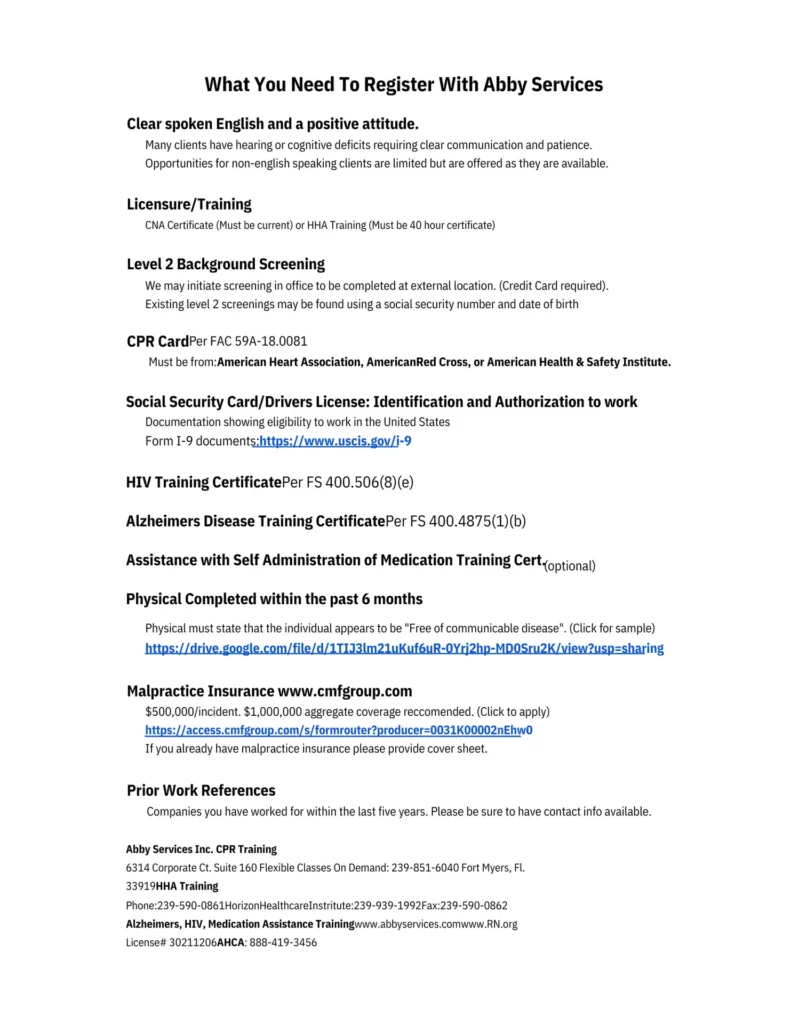
You made it!
Once you have your CNA, you will have many opportunities to find nursing student jobs. With the documents required to register with Abby Services, you can have access to seniors throughout Fort Myers and Cape Coral seeking private care.
Do you have any other questions about nursing student jobs? We can help! just call 239-590-0861!