Free Consultation: Call 239-590-0861 or schedule a call with our local teamSchedule a call

Free Consultation: Call 239-590-0861 or schedule a call with our local teamSchedule a call
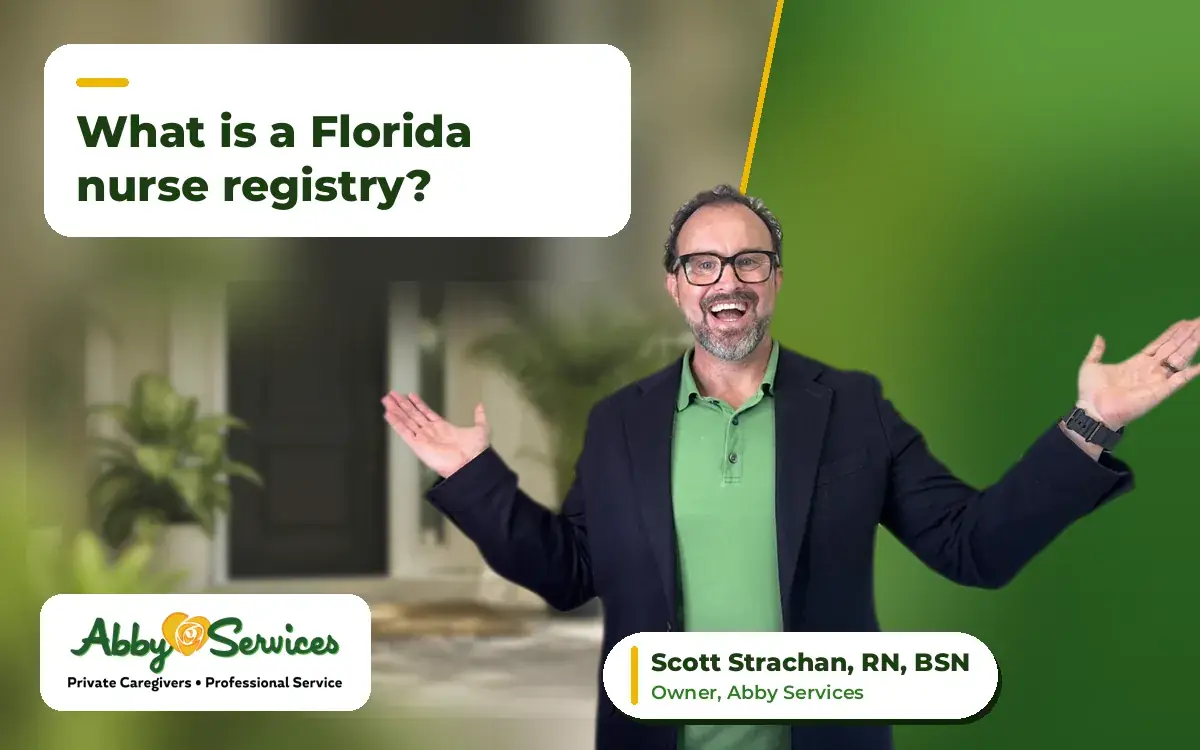
Proudly serving families in Fort Myers, Cape Coral, Naples, Bonita Springs, and surrounding Southwest Florida communities.
A Florida nurse registry is a state-licensed referral service that connects clients with screened, credentialed, independently employed caregivers for in-home care. The registry maintains a list — a registry — of qualified private caregivers, verifies their credentials and background screening, and matches them with clients seeking their services. The client, not the registry, directs the care.
Abby Services has operated as a Florida-licensed nurse registry in Fort Myers since 1997, so this is a question we answer nearly every day. Here is what the term actually means, how the model works, and why it matters for families comparing their in-home care options.
Florida law recognizes two distinct types of licensed in-home care businesses. A home health agency employs its caregivers: it hires, schedules, supervises, and directs them, and builds those employment costs into its rates. A nurse registry does not employ caregivers at all. It refers self-employed, independent caregivers based on the criteria the client provides, and the client decides what services to request and when.
Neither model is “better” — they suit different situations. But the difference is real, and it affects cost, control, and caregiver consistency. Unfortunately, some competitors blur this distinction to steer consumers, which only creates confusion. In our experience, an educated customer is a happy customer, so let’s look at what the state of Florida itself concluded.
In 1999, the Florida House of Representatives conducted a formal review titled Repeal of Nurse Registry Regulation? examining whether the nurse registry statute should be eliminated. The findings were clear: nurse registries deliver in-home care at a 20–30% lower cost than home health agencies, and eliminating them would raise costs and reduce consumer choice.
The report’s recommendation to lawmakers: do not repeal the statute.
Florida House of Representatives, 1999
The reason: nurse registries deliver in-home care at a 20–30% lower cost than home health agencies. Eliminating them would have raised costs for families and reduced their choices.
That statute, Section 400.506, Florida Statutes, still governs nurse registries today. It even requires registries to tell every client, in writing, that referred caregivers are independent contractors — transparency is built into the law.
Nurse registries are licensed and overseen by the Agency for Health Care Administration (AHCA), the same state agency that regulates hospitals and nursing homes. Before a caregiver can be referred, a registry must verify that they meet Florida’s standards, including:
These requirements exist to protect the vulnerable population registries serve. The screening is one of the biggest practical differences between finding a caregiver through a licensed registry and hiring someone “off the street” — a private hire has been through no screening at all unless you arrange it yourself.
Florida regulates nurse registries and home health agencies side by side. Both are licensed by AHCA under the same part of Florida law (Chapter 400, Part III), and their rules run nearly parallel:
Both sets of rules share the same goal: making sure clients are matched with the safest caregivers possible, under consistent statewide standards.
The real difference is the relationship. An agency employs its caregivers. A registry refers independent caregivers, and the client decides whether a referred caregiver is the right fit.
Think of a nurse registry like a realtor or a matchmaking service. A realtor doesn’t build or own the houses they show you — they help you find the right one. A nurse registry doesn’t employ or control caregivers — it helps you find the right one. And like a good realtor, a registry knows the local market: who’s available, whose experience fits your needs, and what in-home care typically costs in your area.
Here’s what that looks like in practice. A family contacts Abby Services looking for help with everyday activities like the ones below. We learn about the client’s needs, schedule, location, and budget, then search our registry of screened independent caregivers to identify good potential matches. Our RN and owner, Scott Strachan, RN, BSN, is available to help you identify the type of support your loved one needs — you decide what to request.
Most long-term care policies and care plans use these six basic activities to describe the help someone needs. Caregivers available for referral through Abby Services can assist with each of them.
Getting in and out of the shower or tub safely, washing, and sponge baths on harder days.
Choosing clothes, buttons and zippers, socks and shoes, and compression stockings.
Getting to and from the bathroom, using a bedside commode, and hygiene afterward.
Moving safely from bed to chair, chair to walker, or in and out of the car.
Cutting food, encouraging fluids, and help at mealtimes when hands or swallowing are a challenge.
Managing incontinence products, changing, and keeping skin clean and dry.
Everyday tasks (IADLs) are the other half of staying home: meal preparation, light housekeeping and laundry, medication reminders, errands and appointments, and companionship.
Learn more about personal care and companion care.
Once we identify good potential matches, two decisions follow. The qualified caregivers registered with Abby Services decide whether to accept the referral, and then the client decides whether the caregiver is a good fit. Caregivers referred through a registry are 1099 independent contractors who set their own rates, choose their own clients, and run their own one-person businesses.
With some agencies, a family gets started with a great caregiver, then the agency pulls that caregiver to start with another client it wants to land. At Abby Services, we don’t interfere. Your caregiver is your caregiver. We don’t reassign or replace anyone unless you or your caregiver asks for a change.
Some families describe their past experience as a revolving door of caregivers, never knowing who to expect. With Abby Services, you get access to your own client calendar in CareLink, showing the times you requested and the caregiver coming for each one, so you always know who’s coming and when.
That is one of the biggest advantages of working with a nurse registry, and it’s why families often see better caregiver consistency than they expected.
Scott Strachan, RN, BSN, Owner
Honesty about the model matters, so let’s be direct. A nurse registry does not provide, supervise, train, or manage caregivers. Care direction belongs to the client, the family, or the client’s physician. The registry’s role is screening, matching, referring, and providing administrative support — things like invoicing and recordkeeping. If you want a company that employs the caregiver for you, that’s what home health agencies do, at a correspondingly higher price. Both options have their place; what matters is choosing knowingly.
In-home care is, by its very nature, directed by the people in the home: the client, a spouse, or another family member. No agency, registry, or anyone who isn’t there routinely can effectively supervise care that happens day to day in someone’s home. See the Big Four nurse registry myths for more.
That’s why a nurse registry treats the client as the boss. You direct the care, and we’re always glad to help you communicate what you want and request.
Three reasons come up again and again with the families we work with:
If you’re in Fort Myers, Cape Coral, Naples, or anywhere in Southwest Florida and want to talk through whether the registry model fits your situation, start your caregiver search here or call us at 239-590-0861. And if you’re a caregiver interested in registry referrals, visit our work as a caregiver page.

Abby Services is a member of the Private Care Association (PCA), the national trade association representing nurse registries and the independent caregivers they refer, with a Florida chapter serving registries across the state. Owner Scott Strachan, RN, BSN, serves as vice president of the Private Care Association of Florida.
It’s a state-licensed matching service for in-home care. The registry screens independent caregivers, verifies their credentials and background checks, and refers them to clients. Caregivers are matched based on the client’s criteria, and the client directs the care; the caregiver works for the client, not the registry.
No. An agency employs and supervises its caregivers. A registry refers independent, self-employed caregivers and does not provide, supervise, or manage the care. Florida licenses both under separate statutes, and the registry model typically costs 20–30% less.
Yes. Florida requires registries to verify Level 2 fingerprint-based background screening and confirm credentials and training before referring any caregiver. That’s a key protection compared with hiring privately, where no screening happens unless you arrange it yourself.
The client, their family, or their physician. The registry can help you identify the type of support needed — at Abby Services, our RN is available for exactly that — but you decide what to request, and the caregiver you work with provides it.
No registry can honestly guarantee that. Caregivers are independent and may accept or decline any referral. What a good registry does is maintain a deep enough roster, and learn your needs well enough, to find you strong matches — and keep looking if the first match isn’t right. In our experience, you don’t marry the first person you go on a date with.
