
Abby Services receives another perfect survey from the Agency For Healthcare Administration.
Yes! Another deficiency free survey for Abby Services! But what does that mean for the seniors throughout Fort Myers & Cape Coral seeking excellent caregivers? It means the patients and families seeking in-home senior care can’t go wrong with Abby Services.
How many deficiency free surveys has Abby Services had?
Our four most recent AHCA standard surveys have all come back deficiency-free — the latest on December 30, 2025. What does it mean to be deficiency free? It means the state arrived unannounced, reviewed our records, our practices, and our caregiver files, and cited nothing. Think of it as getting a really good report card.
| Survey date | Inspection type | AHCA result |
|---|---|---|
| 12/30/2025 | Standard | No deficiencies |
| 12/10/2019 | Standard | No deficiencies |
| 04/18/2018 | Standard | No deficiencies |
| 09/01/2016 | Standard | No deficiencies |
That is four consecutive deficiency-free standard surveys spanning nine years. AHCA publishes these results, so you do not have to take our word for it — look us up yourself on Florida Health Finder.
AHCA’s online portal only goes back to 2013. Abby Services has been licensed and surveyed since 1997, and for most of that time surveys came about every two years. Counting those earlier inspections, we have recorded more than a dozen deficiency-free surveys over the life of the business. We keep those results on file and are glad to share them.
What does a deficiency-free survey mean anyway?
Home Care providers are facing increasing regulatory scrutiny with each passing year. A deficiency-free survey means that Abby Services continues to meet AHCA’s (The Agency for Healthcare Administration’s) standards. Our most recent state inspection confirms it: a 100% deficiency-free survey. It means surveyors reviewed our records, our practices, and our caregiver files, and cited nothing.
Surveys are conducted by AHCA or The Agency For Healthcare Administration. On its website, AHCA states its mission as “Better Health Care for All Floridians.”
They are responsible for the administration of the Florida Medicaid program, licensure, and regulation of Florida’s 48,500 health facilities, including Nursing Homes, and hospitals.
How often do these state inspections take place?
Standard inspections are conducted periodically by the Agency For Healthcare Administration — historically about every two years, though the schedule can vary. Surveyors arrive unannounced and over the course of a day, they interview caregivers & clients, review procedures, and check records for compliance with regulations on care, confidentiality, caregiver screening, patient rights, and quality of services. Abby Services operates at the highest level of quality at all times. We never know when the ‘pop quiz’ will happen, but we are always ready, and our survey records show it.
An excellent state survey means you or your loved one can expect the highest level of service. This is an important factor when considering what In-Home Care Service to use. Some In-Home Care providers are cited for failing to do proper background screenings, failing to maintain specific state-required training, or failing to even maintain a proper business license. These citations only identify issues that were found. Citations result in fines and corrective plans which have to be put in place and followed. Licensed providers’ survey results can be reviewed here.
What you may find in other providers survey results.
Deficiency free survey results can be difficult to achieve. To do so requires a solid knowledge of confusing state regulations. This knowledge must be combined with solid practices to ensure these regulations and guidelines are followed.
Some providers may not have a solid working knowledge of the regulations that govern our industry. This results in incorrectly completed or absent background screenings, missing training to insure a caregiver can competently and safely assist an individual in their home, or even improper or absent emergency plans.
These surveys where non-compliance with state guidelines is discovered require the offending business to correct the issue. if serious enough the deficient findings can result in fines and ultimately suspension of a business license which is required to function.
How to check any provider’s AHCA inspection results
Florida posts inspection reports for licensed home care providers, including nurse registries and home health agencies. You can look up Abby Services, or any provider you are considering, in a few minutes.
- Open AHCA’s public record search.Go to AHCA’s Public Record Search and choose the Statement of Deficiencies tab.
- Choose the provider type and county.Pick “Nurse Registry” or “Home Health Agency,” choose Lee, Collier or Charlotte County, and click Continue.
- Select the provider.Find the name in the list and click Select to see its inspection documents.
- Read the results.A deficiency-free survey has no citations. When a report does list deficiencies, it shows what was cited, and the provider’s plan shows how it was corrected.
For licensing details and any legal actions, the state’s FloridaHealthFinder facility locator is another good place to look.
Compare at least two or three providers the same way. If a report lists deficiencies, ask the provider what happened and what changed. A good provider will explain it plainly.
How do you know if the senior care service is deficiency free?
A deficiency free survey demonstrates that a Senior Caregiver Service is following required state guidelines. You can look up those results yourself using the steps above.
You could just ask. All licensed senior care businesses are required to have their deficiency reports available on site. The business should know what deficiencies they had and what action was taken to correct them. (More alarming is if they dont know their deficiencies or actions taken to correct them).
Abby Services is proud to share our results. Our history of deficiency-free surveys shows in the caregivers our clients work with.
Nursing Student Jobs: Real world work experience.
There are plenty of nursing student jobs in Fort Myers and Cape Coral. However, not all of them provide real world caregiver experience. As a CNA providing private in-home care, nursing students can gain valuable real world patient experience.
Why a nursing student should work as a CNA.
My name is Scott Strachan, I am an RN and administrator of Abby Services. We help seniors and their families find safe, effective caregivers to help them remain safe and independent in their homes.
While in Nursing School I worked as a CNA providing in-home care to seniors throughout Fort Myers & Cape Coral. The experience taught me things that are difficult to cover in traditional nursing school including:
- Interacting with patients.
- Appropriate bedside manner.
- How to provide compassionate support.
As a nursing student, working as a CNA has more benefits other than the experience gained. As an in-home caregiver, nursing students will have flexible work schedules that can accommodate frequently changing class and clinical schedules.
It’s also important to recognize that as an in-home caregiver, students can earn top pay while gaining real-world experience that can be included on their resumes.
How can a nursing student work as a CNA?
CNA stands for Certified Nursing Assistant. While there are formal classes and training available for those pursuing this as a career Nursing Students often already have the skills and training necessary to provide CNA-level care.
There is an option to “challenge” the CNA exam. With a student’s training challenging the exam is often the most cost-efficient way to enter this field. To work as a CNA and find nursing student jobs as a CNA, you must have passed the CNA exam and hold a CNA certificate.
Challenging the CNA exam: One way to find nursing student jobs.
In the state of Florida, being a CNA is a regulated profession. CNA licensure is overseen by the Florida Board Of Nursing. This link covers how to challenge and earn your Certified Nursing Assistant (CNA) by examination.
Unfortunately, the board is not super clear on the steps especially the cost of challenging the exam. If you are reading this, you are probably busy and seeking nursing student jobs so we are here to help. Read on for details on the steps to take to earn your CNA as a nursing student.
Steps to challenge the CNA exam.
The Florida Board of Nursing covers the process to challenge the exam here. The cost is not clear because testing is outsourced to a service called Prometric.
You will need to submit an application to challenge the CNA exam to Prometric as well as fingerprints necessary to complete a level 2 background screening. This can all be completed online with Prometric here.
Details about the fingerprinting are available here and will be subject to an additional fee. (Costs can vary but are generally $70-$90.)
Prometric also has a printable CNA examination application. At the time this was written the cost to challenge the CNA exam was $155. This includes both the written portion and clinical portion of the exam.
Important resources if you are challenging the CNA exam.
Prometrics has some important information about challenging the CNA exam. You will want to closely review this to be sure you are properly prepared. If you are a nursing student seeking jobs as a CNA much of this content should have already been covered as part of your training but it is still important to review.
- Clinical Skills Checklist: This checklist covers what the evaluator may assess.
You are almost there!
Earning your CNA certificate is one component to working as a CNA. Depending on where you apply there may be additional requirements.
Abby Services is a state-licensed Nurse Registry. Abby Services follows all state requirements for CNAs to provide in-home care. We also have some requirements in place to protect the caregivers and clients we work with. The following is a list of required documents Abby Services collects for all caregivers.
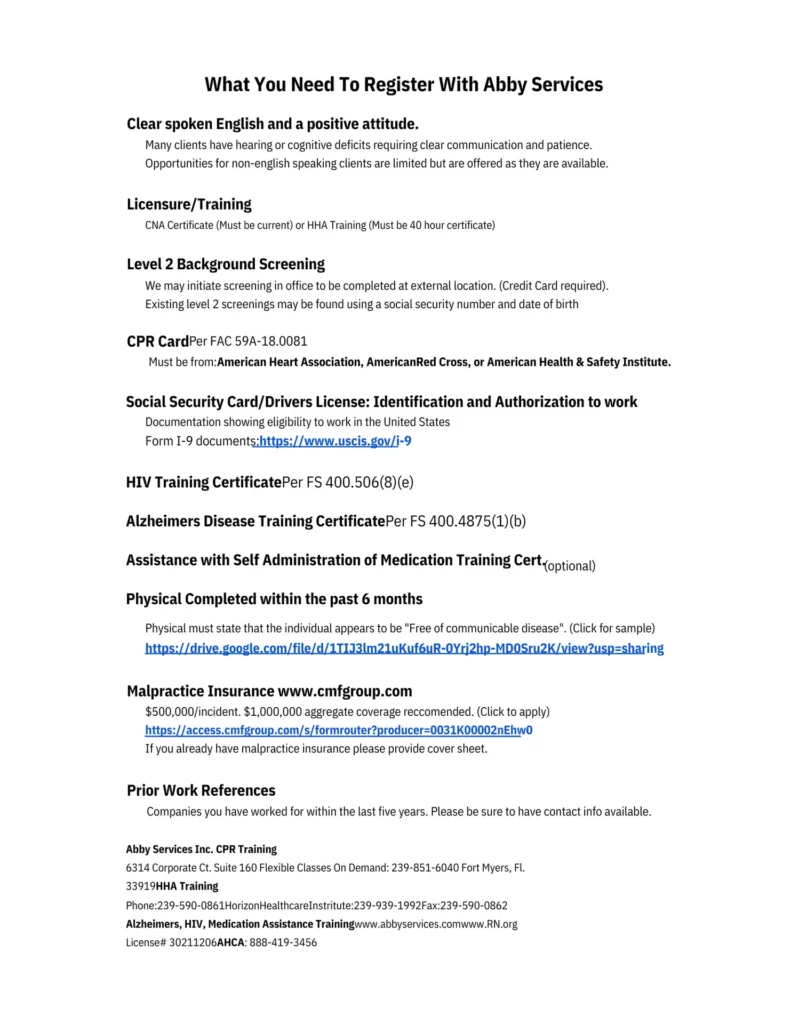
You made it!
Once you have your CNA, you will have many opportunities to find nursing student jobs. With the documents required to register with Abby Services, you can have access to seniors throughout Fort Myers and Cape Coral seeking private care.
Do you have any other questions about nursing student jobs? We can help! just call 239-590-0861!
If you’re a CNA or HHA weighing an in-home care job against a nursing home job, here’s the answer most people miss: you don’t have to choose. The smartest caregivers often do both. A nursing home job gives you a steady paycheck, benefits, and a predictable baseline. Private in-home clients — the kind a nurse registry like Abby Services refers — give you higher pay, control over your schedule, and a lighter workload of one or two clients instead of a whole wing. Combined, you get the stability of an employer and the freedom and income of private work. Here’s how that works, and why it’s worth considering.
A quick word on where this comes from. My name is Scott Strachan. I’m a Registered Nurse and the owner of Abby Services, and I’ve worked both sides of this — as a CNA in private client homes, in nursing homes, and in hospitals, and later as a nurse in those same settings. I’m not knocking nursing home work; it’s honorable, and it taught me a lot. But I’ve seen firsthand what caregivers gain when they add private in-home clients to the mix.
What a Nursing Home Job Gives You
Let’s be fair to the nursing home side, because it has real advantages, especially as a foundation:
- A steady, predictable paycheck and set hours you can count on.
- Employee benefits — health insurance, paid time off, and retirement contributions that an employer provides.
- Built-in structure and support — a team around you, supervisors, and established routines.
- W-2 employment, with taxes withheld for you rather than something you manage yourself.
For many caregivers, that stability is the anchor. The mistake is assuming it has to be the whole picture.
What Private In-Home Clients Add
Working with private clients referred through a nurse registry is a different experience, and it fills the gaps a facility job leaves:
- Higher pay. Private in-home care in our area generally pays significantly more per hour than facility caregiver wages. You can compare current local caregiver pay on sites like the Bureau of Labor Statistics or Indeed, and private-duty rates typically sit above the facility average.
- One or two clients, not a wing. In a nursing home, a single caregiver may be responsible for 10, 15, or more residents on a shift. With private in-home care, you focus on one person. The work is more manageable and the care is better.
- Schedule control. As a self-employed caregiver taking private referrals, you decide which opportunities fit your life. You set your availability around your facility job, your family, or your classes.
- You set your rate. Caregivers referred through a registry are independent contractors who negotiate their own pay directly with the client — you’re running your own small business.
- Real relationships. One-on-one care lets you actually know the person you’re helping, which is why most caregivers got into this work in the first place.
Why “Both” Beats “Either”
Here’s the combination that works so well. Keep the nursing home job for the stability and benefits — the W-2 base that covers your insurance and gives you a floor. Then take private in-home clients through Abby Services around that schedule, for the higher pay and flexibility. You’re not gambling your security to chase better pay; you’re adding better pay on top of your security.
Plenty of caregivers use private in-home work exactly this way: to fill open days, pick up higher-paying hours between visits, or build toward eventually going independent full-time once they’ve established a steady base of private clients. Because you control your availability, private work bends around your life instead of competing with it.
A Note for Nursing Students
If you’re in nursing school, this combination is even more valuable. Private in-home CNA work offers the flexible scheduling that fits around clinicals and classes, pays well, and gives you real one-on-one patient experience that’s hard to get anywhere else — the kind that makes you a better nurse and stands out on a resume. Many students find private in-home care the ideal way to earn while they learn.
How to Add Private Clients Through Abby Services
Abby Services is a state licensed nurse registry in Fort Myers. We don’t employ caregivers — we refer screened, qualified CNAs and HHAs to private clients who need in-home care, and we handle the administrative side (matching, invoicing, and payment processing) so you can focus on the care. You stay independent, set your own rate and schedule, and take the referrals that fit.
To be considered for referrals, you’ll need to meet Florida’s registration and Level 2 background-screening standards for the services you offer. If you’re a CNA or HHA in Lee, Collier, or Charlotte County and you’d like to add private in-home clients to your work, we’d like to hear from you.
Ready to add higher-paying private clients to your schedule?
Abby Services has connected Southwest Florida caregivers with private clients since 1997. Whether you want a few extra hours a week or a path toward independent work, we can help you build it.
Have questions about care at home?
Talk it through with a registered nurse.
Frequently Asked Questions
Can I take private in-home clients while keeping my nursing home job?
Yes, and many caregivers do exactly that. Because caregivers referred through a registry are independent contractors who set their own availability, you can take private clients around your facility schedule — keeping the benefits and stability of your employer while adding higher-paying, flexible private work.
Does in-home care really pay more than nursing home work?
Private in-home care in Southwest Florida generally pays more per hour than facility caregiver wages, and you typically care for one client instead of many. Exact rates vary; because you’re an independent contractor, you negotiate your rate directly with the client.
Am I an employee of Abby Services?
No. Abby Services is a nurse registry — we refer caregivers to private clients and provide administrative support. The caregivers we refer are self-employed independent contractors who set their own rates and schedules. Under Florida law, a caregiver referred by a licensed nurse registry is an independent contractor, not an employee of the registry.
What do I need to take private clients through Abby Services?
You’ll need to meet Florida’s registration and Level 2 background-screening requirements for the services you provide (for example, an active CNA certification or documented HHA training). Contact us and we’ll walk you through what’s needed.
Sources
If you’re a caregiver working with a Florida nurse registry, you are almost certainly a 1099 independent contractor, not a W-2 employee, because that is exactly what Florida law requires. Florida law addresses this directly: Florida Statute 400.506 specifically defines caregivers referred by a licensed nurse registry as independent contractors, not employees of the registry. That means you run your own small business, you receive a 1099 rather than a W-2, and you’re responsible for your own taxes. This page explains what that means, why it’s the case, and where to get help.
- Florida law defines caregivers referred by a licensed nurse registry as independent contractors.
- You run your own business: you set your own rates and choose which referrals to accept.
- You receive a 1099, and you are responsible for paying your own taxes.
- For advice on your own tax situation, talk with a CPA.
A quick, important note. My name is Scott Strachan. I’m a Registered Nurse and the owner of Abby Services, and I am not a tax professional. Nothing here is tax advice for your specific situation — always speak with a CPA. What this page does is explain how a Florida nurse registry works and point you toward reliable information, because we’ve seen a lot of misleading and even false tax guidance aimed at caregivers, and you deserve accurate sources.
You’ll See Conflicting Information Online. Here’s Why.
If you search online about caregivers working as independent contractors in home care, you’ll find some people making false blanket statements, such as “you can’t do that” or “you’ll get in trouble.” Those people are either misinformed or misleading you. It’s true that some states have no laws on this, and some expressly prohibit caregivers from working as independent contractors in home care. But Florida law specifically outlines, describes, and governs independent contractors working in home care.
If you search for caregiver taxes, you’ll find many articles insisting that caregivers must be treated as W-2 household employees, not 1099 contractors. That advice is written for a different arrangement: a family that hires a caregiver directly and becomes that caregiver’s employer. Some states actually encourage this domestic employer model, where the client becomes the caregiver’s employer and handles payroll taxes. It’s a legitimate option, but it isn’t how a Florida nurse registry works.
A nurse registry is a different arrangement. A registry refers self-employed caregivers to clients and provides administrative support. That is why the classification comes out differently, and it’s backed by both Florida law and federal guidance.
You are an independent professional
Caregivers referred through a nurse registry run their own businesses. You set your own rates, choose which referrals to accept, and can work with more than one client. Your clients decide what help they want, and you decide how best to provide it, using your professional training and judgment.
Think of it like seeing a doctor. Patients are in control of their own health care: they share their concerns and decide which treatment they’re comfortable with. The doctor decides how to deliver that treatment, using their own training and judgment. Being in charge of your own care doesn’t make you your doctor’s employer.
Caregiving works the same way. A client might ask you to change the bed for a loved one who can’t get up. You know how to change the sheets with a full-grown adult still in the bed, safely turning and positioning them as you work. That’s a professional skill, and how it’s done is up to you. A client asking for clean sheets is describing the help they want. It doesn’t make them your employer.
Health care already works this way. Many of the physicians you see in a hospital are not hospital employees. At NCH, for example, emergency, anesthesia, radiology, and pathology physicians come from contracted physician groups that bill patients separately. Even Medicare-certified home health agencies, which follow strict federal rules, are allowed to arrange services such as physical therapy through outside providers under written agreements.
The Florida Law: Caregivers Referred by a Registry Are Independent Contractors
Florida spells this out directly. Under Florida Statute § 400.506(6)(d), a registered nurse, LPN, certified nursing assistant, home health aide, companion, or homemaker referred for contract by a nurse registry “is deemed an independent contractor and not an employee of the nurse registry under any chapter.”
The same statute requires the registry to tell the client, at the time of contract, that the referred caregiver is an independent contractor and that the registry may not monitor, supervise, manage, or train the caregiver. In other words, the independent-contractor relationship isn’t a workaround a registry chooses — it’s how Florida defines and regulates the nurse registry model.
The Federal Guidance: DOL Field Assistance Bulletin 2018-4
The U.S. Department of Labor addressed nurse registries directly
In Field Assistance Bulletin No. 2018-4, “Determining Whether Nurse or Caregiver Registries Are Employers of the Caregiver,” the Department of Labor made its position clear: a registry that refers caregivers and provides administrative services, such as recordkeeping, invoicing, and collecting and disbursing payment, is not the caregiver’s employer under the Fair Labor Standards Act.
It is the most direct federal guidance on the nurse registry model, and it lines up with how Florida law defines it.
That’s why Abby Services leaves rates and schedules for clients and caregivers to agree on together.
One point worth being precise about: FAB 2018-4 concerns federal wage-and-hour law, which is a separate question from how the IRS treats a worker for taxes. Caregivers referred through a nurse registry operate as independent professionals and receive a 1099. For questions about your own tax situation, talk with a CPA.
What Abby Services Does — and Doesn’t Do
Abby Services is a state licensed nurse registry overseen by Florida’s Agency for Health Care Administration (AHCA). Our role, consistent with Florida law and DOL guidance, is limited to referral and administration:
- We verify that caregivers meet Florida’s registration, training, and Level 2 background-screening standards before referral.
- We refer screened caregivers to clients whose needs may match the caregiver’s experience and availability.
- We provide administrative support — invoicing, recordkeeping, and collecting and disbursing client payments.
- We help caregivers keep track of their earnings throughout the year, and their annual 1099 is available to view and download through CareLink.
What we do not do — and legally may not do — is employ, supervise, direct, or set the pay of the caregivers we refer. The caregiver and client set their own rate and schedule directly. We refer 1099 caregivers to families throughout Fort Myers, Cape Coral, Naples, and Bonita Springs.
Run It Like a Business
The strongest answer to anyone who questions your independent-contractor status is how you actually work. The IRS and the Department of Labor both look at whether a worker is truly in business for themselves. These habits show that you are:
- Set your own rates, and put your agreements with clients in writing.
- Accept or decline referrals based on what works for your business.
- Work with more than one client when you can.
- Carry your own professional liability (malpractice) insurance.
- Keep your license, certifications, and training current.
- Keep your own records of earnings and business expenses.
- Pay estimated taxes and work with a CPA.
The IRS Self-Employed Individuals Tax Center is a good place to start for the tax side.
What Being a 1099 Caregiver Means for Your Taxes
As an independent contractor, you operate your own business, which changes how taxes work compared with an employee:
- No taxes are withheld for you. A client doesn’t withhold income tax or FICA from your pay the way an employer would. You’re responsible for setting money aside.
- You pay self-employment tax. Independent contractors pay both the employee and employer share of Social Security and Medicare (15.3%), because there’s no employer covering half.
- You may owe estimated taxes quarterly. Rather than settling up once on April 15, self-employed individuals generally pay estimated taxes throughout the year.
- You’ll receive a 1099. A 1099 reports your earnings to you and the IRS once they reach the reporting threshold, which is $2,000 or more for payments made in 2026 and later ($600 for earlier years). All of your earnings are taxable, whether or not you receive a 1099.
- You may be able to deduct business expenses. As a business owner, certain work-related costs may be deductible — a CPA can tell you which apply to you.
Running your own business also means protecting it. We strongly encourage caregivers to carry their own private malpractice insurance. It protects both you and the clients you care for, and many families ask for it.
Families hear their share of tax myths too. If a client has been told they will be responsible for your taxes, point them to the Big Four nurse registry myths.
To make tax time easier, keep good records of your earnings throughout the year. Abby Services works together with CareLink, a secure platform where the caregivers we work with can receive client payments, track those earnings for tax reporting, and view and receive their annual 1099.
Interested in working as an independent caregiver in Southwest Florida?
Abby Services stays informed on the changing federal and state guidelines that affect nurse registries and the 1099 caregivers we work with, in part through our involvement with industry groups like the Private Care Association (PCA). We’re always glad to explain how our business operates. For questions about your own tax situation, please talk with a CPA.
Have questions about care at home?
Talk it through with a registered nurse.
Frequently Asked Questions
Who is my boss?
You are your own boss. As an independent professional, you make the important decisions about your business: which referrals to accept, what rates to set, and how you provide your services. Abby Services is here as a resource and to support your business behind the scenes, including:
- Referring clients whose needs may fit your skills and availability
- Verifying your credentials and background screening
- Handling invoicing and payment processing
- Keeping records and helping you track your earnings, with your 1099 available through CareLink
- Helping with long-term care insurance paperwork when a client uses it
Are caregivers referred by Abby Services employees or independent contractors?
Independent contractors. Under Florida Statute 400.506(6)(d), a caregiver referred for contract by a licensed nurse registry is deemed an independent contractor and not an employee of the registry. The caregivers we refer operate their own businesses; we provide referral and administrative services only.
Why do some websites say caregivers must be W-2 employees?
That guidance is written for families who hire a caregiver directly and become that caregiver’s employer. A nurse registry is a different arrangement: the registry refers self-employed caregivers who run their own businesses, which is why Florida law and DOL Field Assistance Bulletin 2018-4 treat registry-referred caregivers as independent contractors, not employees of the registry.
Where do I get my 1099?
Your 1099 is available to view and download through CareLink, the secure platform where you receive client payments and track your earnings. You use it to file your taxes. All of your earnings are taxable, even if they fall below the 1099 reporting threshold.
Do I have to pay my own taxes as a 1099 caregiver?
Yes. As an independent contractor, no taxes are withheld for you. You’re responsible for income tax and self-employment tax (Social Security and Medicare), and you may need to pay estimated taxes quarterly. A CPA can help you set up the right approach for your situation.
Sources
- Florida Statutes § 400.506 — Licensure of nurse registries (see subsection (6)(d))
- U.S. Department of Labor Field Assistance Bulletin No. 2018-4
- IRS: Independent Contractor (Self-Employed) or Employee?
- IRS: Self-Employed Individuals Tax Center
- IRS: Form 1040-ES, Estimated Tax for Individuals
- NCH: Contracted Hospital-Based Physician Groups
- 42 CFR 484.105: Home health agency services, including services under arrangement
This article is general information about how a Florida nurse registry operates, not tax or legal advice. Consult a CPA or qualified professional about your specific situation.
Abby Services is a Nurse Registry licensed and overseen by the Agency fo Healthcare Administration.
One important rule for in-home healthcare providers is requiring in-home caregiver health screenings for every HHA & CNA who enters a senior’s home.
The Agency for Healthcare Administration or (AHCA) safeguards seniors is by enforcing these laws, rules, and regulations in Hospitals, Nursing Homes, and other licensed entities including Abby Services.
So what is an in-home caregiver health screening?
AHCA or The Agency For Healthcare Administration lays out guidelines that are designed to help protect the population we serve. One such example is the requirement of a health statement from a health care professional certifying that an individual is “Free of communicable disease”. The exact verbiage can be found here under FAC59A-18.005(6). This is required for every caregiver who enters a seniors home.
What does a health statement screen for?
That’s a fair question. Abby Services follows all state requirements for caregiver screening and selection. Including the requirements for in-home caregiver health screenings.
That being said, clients often ask “Will my caregiver be screened for HIV?”, Will my caregiver be screened for the Flu?”, Will my caregiver be screened for TB or Tuberculosis?”, “What are you doing about the Zika Virus?”. There are many other valid questions related to health screening.
These are very good questions. The reality is that it is impossible and cost-prohibitive to effectively screen for every possibility, which is why we defer to the regulations and requirements that govern our industry. That’s why we rely on a general practitioner’s judgment to screen for a caregiver’s general wellbeing.
What if I want my caregiver to have additional health screenings?
One of the most common requests, beyond a general Health Statement, is for Tuberculosis Screening, specifically when a caregiver is caring for a patient residing in a Nursing Facility. While some facilities may choose to further protect their residents by requiring TB (tuberculosis) screening.
AHCA phased out the requirement for this testing in our industry years ago in favor of the health statement from a medical professional screening a caregiver for a number of ailments.
Clients may request whatever additional testing they believe is necessary from their caregiver, however, both client and caregiver should consider the cost and benefit of insisting on safeguards above and beyond those required by The Agency for Healthcare Administration.
For those interested here is a link to our local Department of Health’s TB testing program. The Department of Health also has other immunization programs available for those who are interested.
Should you have any questions or concerns, we encourage you to speak with Scott Strachan who is an RN and one of the owners of Abby Services. He is well versed in our state requirements and how to help seniors remain safe and independent in their homes.