Free Consultation - Call: 239-590-0861

Free Consultation - Call: 239-590-0861
Proudly serving families in Fort Myers, Cape Coral, Naples, Bonita Springs, and surrounding Southwest Florida communities.
Regular exercise is one of the most effective things a person with Parkinson’s disease can do alongside medication. The Parkinson’s Foundation recommends at least 2.5 hours of exercise a week, mixing aerobic activity, strength training, balance and agility work, and stretching, because people who stay active tend to move better, fall less, and keep their quality of life longer. In Fort Myers and Cape Coral, that can mean free Lee Health movement classes, Rock Steady Boxing, water aerobics, tai chi, or a daily walk with a caregiver who keeps things safe. This guide covers what kind of exercise helps, how much, where to find classes locally, and how a private caregiver can help your loved one keep moving.
This is general information, not medical advice. Talk with your neurologist or a physical therapist who specializes in Parkinson’s before starting a new program.
Parkinson’s affects movement, balance, and coordination. Walking on a flat floor can become harder, turns and doorways can trigger freezing, and posture tends to stoop forward. Exercise does not cure Parkinson’s, but research consistently shows that regular, targeted activity helps people keep strength, flexibility, balance, and walking speed, and can ease stiffness, low mood, fatigue, and sleep problems.
The biggest practical reason is falls. Falls are one of the most common and serious complications of Parkinson’s, and a fall that ends in a broken hip or a hospital stay can set someone back for months. Strength, balance, and agility training lower that risk, and a stronger body recovers better when a fall does happen.
The Parkinson’s Foundation and the American College of Sports Medicine recommend four types of exercise, adding up to at least 150 minutes a week:
A few tips that make a big difference:
These programs were confirmed active in September 2026. Schedules and prices change, so call first, and let them know Abby Services referred you.
Lee Health runs a free navigation, education, and movement program for Lee County residents with Parkinson’s and their care partners. It includes Parkinson’s exercise classes (in person in Cape Coral, Fort Myers, and Estero, and online), water aerobics for Parkinson’s, tai chi for better balance, a monthly care partner group, and young-onset dinners. It is a navigation and education program, not medical care, and it is the best first call for most local families.
Rock Steady Boxing is a non-contact boxing program built for people with Parkinson’s. Classes use punching bags, footwork, and agility drills to work on speed, balance, coordination, and strength, and they are grouped by ability level. No boxing experience is needed, and a short assessment is required before your first class.
For days when getting to a class is not realistic, the Parkinson’s Foundation exercise page offers free guidance and follow-along videos, and its helpline at 1-800-473-4636 (1-800-4PD-INFO) can answer questions and point you to programs. Lee Health’s Parkinson’s exercise classes are also available online.
The hardest part of exercise with Parkinson’s is often not the exercise. It is getting to class on time during “on” hours, having someone steady nearby during balance work, and remembering the home routine on the days in between. That is where a private caregiver helps.
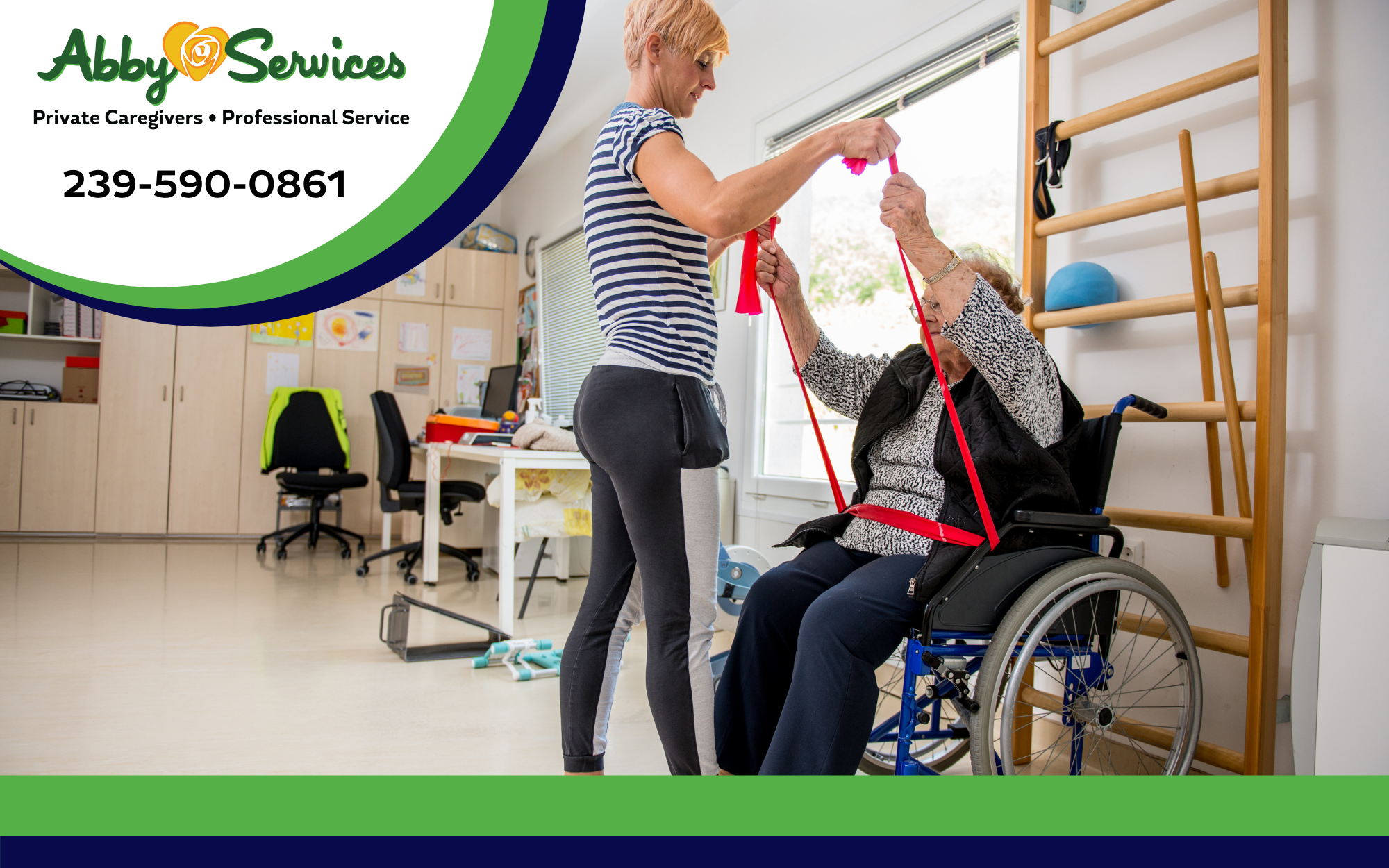
A caregiver referred through Abby Services can drive your loved one to Rock Steady Boxing or a Lee Health class and walk them in, keep medications on schedule so exercise lands during “on” time, stand by during the home exercise routine the physical therapist taught, go for the daily walk, and give the family caregiver a break to go to the care partner group. See our senior transportation guide for other ride options.
Parkinson’s care is personal for Abby Services, and our Parkinson’s caregiver support page explains why. The caregivers we refer help with bathing, dressing, and personal care as movement slows, fall prevention, meals, and companionship, from a few hours a week to live-in and 24-hour care as needs grow. Families in eastern Lee County can see our page on Parkinson’s support in Lehigh Acres. If Parkinson’s brings memory or thinking changes, our dementia caregiver support can help, and for advanced Parkinson’s that makes office visits hard, see our guide to house-call doctors in Fort Myers.
Abby Services is a nurse-owned, state-licensed nurse registry in Fort Myers. Since 1997 we have matched families across Lee, Collier, and Charlotte Counties with screened, credentialed private caregivers who are independently employed and directed by the family. Call 239-590-0861 or tell us what you need online. Our guides to the cost of in-home care and VA Aid and Attendance can help with planning.
The Parkinson’s Foundation recommends at least 150 minutes (2.5 hours) of exercise a week, combining aerobic activity three days a week, strength training two to three days, balance and agility work two to three days, and stretching, ideally daily. Check with a neurologist or Parkinson’s physical therapist first.
There is no single best exercise. A mix of aerobic, strength, balance, and stretching works best. Programs designed for Parkinson’s, such as Rock Steady Boxing, tai chi, LSVT BIG, cycling, and water aerobics, are popular because they combine several of these and are adapted for different ability levels.
Yes. The Lee Health Parkinson’s Disease Program offers free exercise classes, water aerobics, and tai chi for Lee County residents with Parkinson’s, in person in Cape Coral, Fort Myers, and Estero and online. Call 239-343-9243.
The Sweet Science Boxing and Fitness offers Rock Steady Boxing in Cape Coral (239-994-9265) and South Fort Myers (239-220-9125). A short assessment is required before the first class.
Yes. A private caregiver can drive your loved one to classes, keep medications on schedule so exercise happens during “on” time, stand by for safety during a home exercise routine prescribed by a physical therapist, and go on daily walks. Caregivers do not replace a physical therapist.
